Quick answer
If you are working out how to write FAQ questions, start from what customers already ask: the support inbox, chat, calls, reviews and Search Console queries. Copy each question in the customer's words, log and tag it, count the repeats, and answer each one in its first sentence. Questions people search on their own get their own page; the rest stay on the FAQ.
Key takeaways
- Write FAQ questions from what customers already ask, copied in their words, not from what you wish they asked.
- Google's SEO Starter Guide: "Think about the words that a user might search for to find a piece of your content."
- In a Nov 10, 2026 test, 1 of the 21 FAQ questions on my home page and service pages came back as a Google autocomplete suggestion; short topic phrases for 15 of the 21 returned suggestions.
- Search Console's Performance report lists question queries with a Custom (regex) filter, and Google says regex matching is not case-sensitive by default.
- Google's FAQ rich result stopped appearing in Search on May 7, 2026, so write FAQs for readers, not for a search feature.
- The person who answers the inbox should log the questions, and the job description should say so.
On this page (11)
How do you write FAQ questions?
To write FAQ questions, copy them from what customers already ask you, in their own words, then answer each one in its first sentence and give every question its own entry.
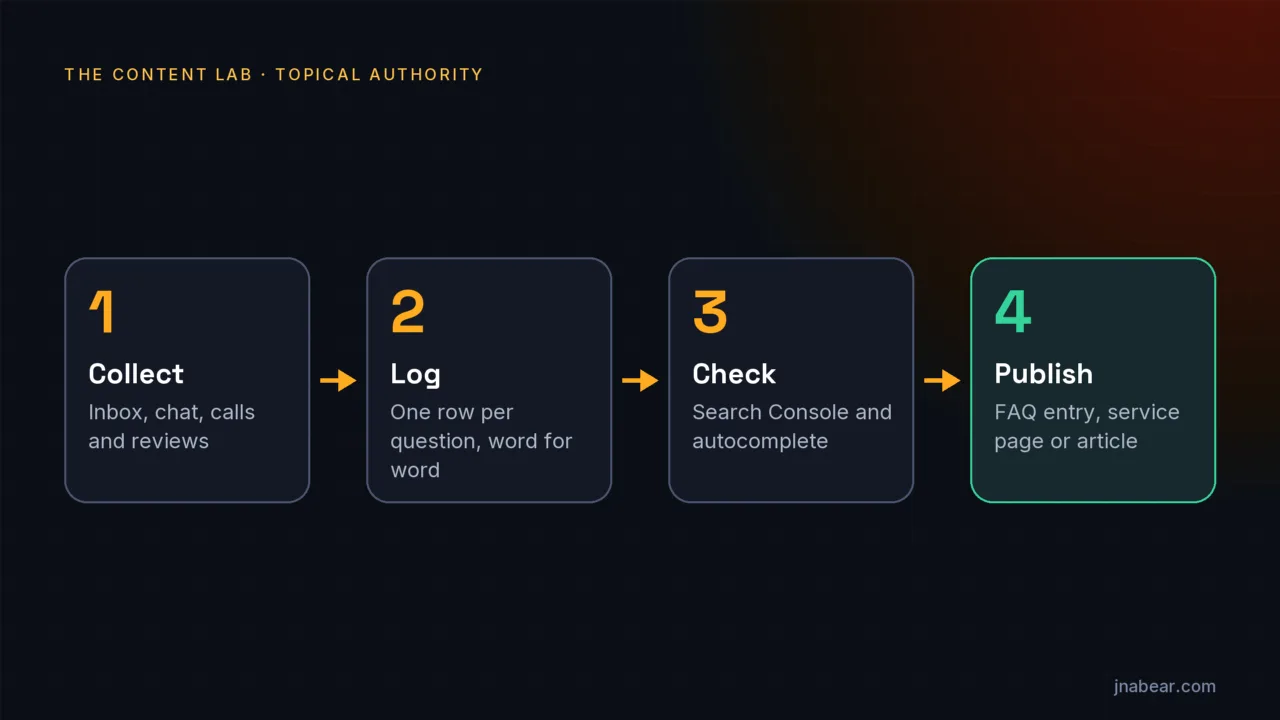
Most FAQ pages go wrong the same way: the owner writes the questions they wish people asked. Real questions arrive every day by email, chat, phone and review. Your support inbox is keyword research you already have, written by the people you want to reach. Here is how to write FAQ questions from it, step by step:
- Collect: pull questions from the inbox, chat, call notes and reviews.
- Log: one row per question, copied word for word, with the date and channel.
- Tag: give each question a topic and a stage (before, while or after buying).
- Count: once a week, count the repeats by topic. Repeats go first.
- Check: compare the wording with Search Console queries and Google autocomplete.
- Place: decide whether the answer belongs on the FAQ page, a service page or its own article.
- Write: the question in the customer's words, the answer in the first sentence.
Where do good FAQ questions come from?
Good FAQ questions come from the places customers already ask: the support inbox, contact forms, live chat, phone calls, reviews, and the search queries listed in Google Search Console.
| Source | What it shows | How to pull questions from it |
|---|---|---|
| Support inbox and tickets | Questions from people who bought, or are about to | Search the inbox for "?" and log one question per message |
| Contact form and chat | Questions asked before a first purchase | Export the messages and keep the first question in each |
| Phone and sales calls | Price questions and objections | Write the question down in the caller's words right after the call |
| Reviews, yours and competitors' | What surprised or annoyed buyers | Turn each complaint into the question behind it |
| Search Console queries | Questions people typed before they found you | Filter queries with a question-word regex (below) |
| Google autocomplete | Common phrasings of a topic | Type the topic and note the suggestions |
The support inbox is usually the richest source, because each message is a question someone cared enough to send. Reviews add the questions people did not think to ask before they bought. Those are often the ones most worth answering up front. Google's guidance on people-first content asks, "Does the content provide original information, reporting, research, or analysis?" Your customers' questions, and your answers to them, are something no other site has first.
Why should FAQ questions use the customer's words?
FAQ questions should use the customer's words because people search in their own vocabulary, not the seller's, and a reader spots their own question faster when it sounds like them.
Google's SEO Starter Guide says it plainly: "Think about the words that a user might search for to find a piece of your content." It adds that "Users who know a lot about the topic might use different keywords in their search queries than someone who is new to the topic," with the example of "charcuterie" versus "cheese board." A customer writing to your inbox is usually the one who is new to the topic. Their words are the cheese-board words.
The same guide says not to worry about every variation, because Google's "language matching systems are sophisticated." So the aim is not to match every phrasing. The aim is to ask each question the way a customer would, so the right reader recognizes it at a glance.
Do FAQ questions match what people search on Google?
Most of my own FAQ questions do not match Google searches word for word: on Nov 10, 2026, I typed the 21 FAQ questions on my home page and service pages into Google autocomplete, and only one came back as a suggestion, while 15 of the 21 topic phrases underneath returned suggestions.
The 21 questions are the ones on my home page and service pages. I wrote all of them myself; none came from a customer inbox. I sent each question to Google's autocomplete in lowercase, without the question mark. Then I typed a short topic phrase for each, the way a searcher might start, and noted the closest suggestion.
| Question as published here | Full question suggested? | Topic typed | Closest suggestion |
|---|---|---|---|
| What does an SEO content strategy include? | No | seo content strategy | seo content strategy example |
| Does Google penalize AI-generated content? | Yes, without the hyphen | does google penalize ai | does google penalize ai content |
| How is JNAbear different from a content mill? | No | content mill | content mill meaning |
| How quickly will I see results? | Off topic (weight loss, workouts) | how long does seo take | how long does seo take to show results |
| Do you work with businesses anywhere in the US? | No | seo company that works nationwide | None |
| Do you guarantee rankings or AI citations? | No | seo guarantee | seo guaranteed results |
| What do I get from the free audit? | No | free seo audit | free seo audit report |
| Do I need to rebuild my website for a local SEO cluster? | No | do i need a new website for seo | do i need a website for seo |
| How many pages are in a local SEO cluster? | No | how many pages for local seo | None |
| Is a local SEO cluster just blogging? | No | is local seo | what is local seo in simple words |
| Can AI content humanization match our existing voice? | No | humanize ai content | humanize ai content prompt |
| Will humanized AI content pass AI detectors? | No | humanized ai content detect | how to detect humanized ai content |
| Does AI content humanization help with E-E-A-T? | No | does ai content hurt eeat | None |
| Can my team act on a topical map without you? | No | topical map | topical map in seo |
| Does topical authority mapping help with AI search? | No | topical authority ai | what is topical authority |
| How big a site can a content audit cover? | No | content audit | how to do a content audit |
| Do you implement the content audit fixes? | No | content audit implementation | None |
| Can you write conversion copy from a wireframe? | No | copywriting wireframe | copywriting wireframe |
| Is conversion-focused copy still written for SEO? | No | conversion copywriting seo | None |
| Who designs and builds a JNAbear website? | No | web designer that does seo | None |
| Do you build sites for businesses anywhere in the US? | No | seo services for small business | seo services for small businesses |
Autocomplete test data, Nov 10, 2026 (CSV)
All 21 questions, both queries for each, and every suggestion Google returned.
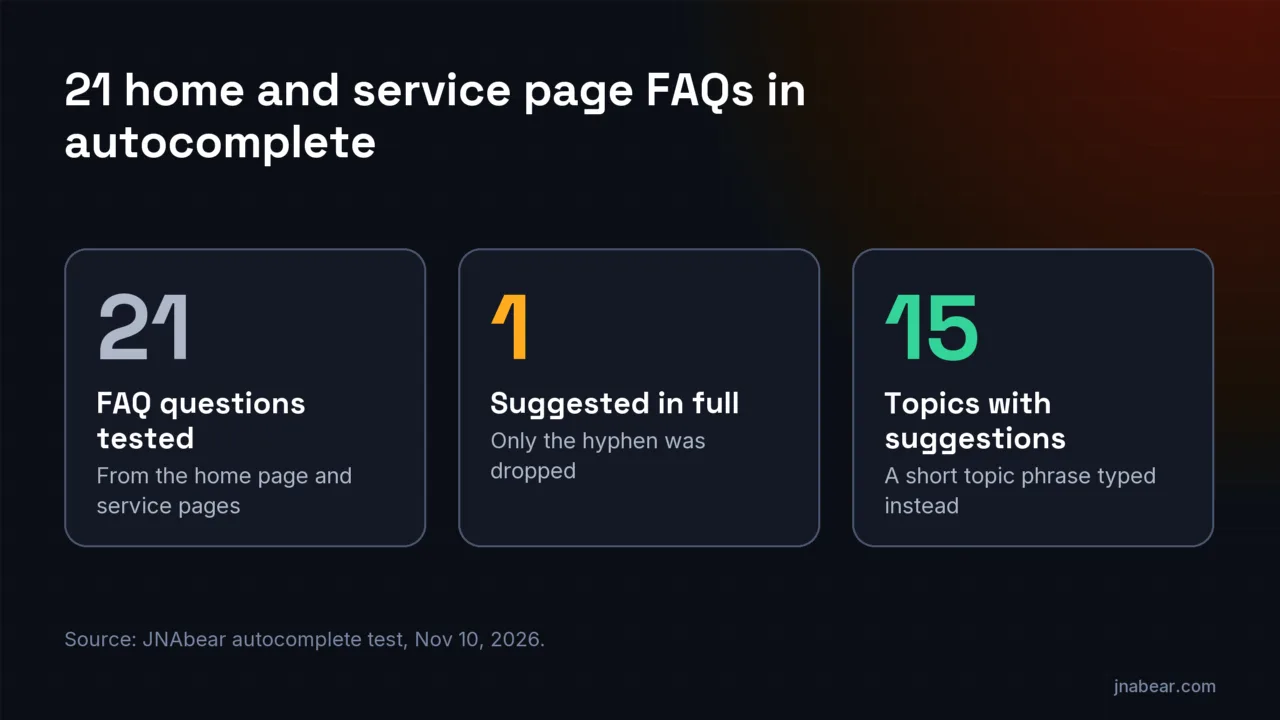
Three things stood out. Only "Does Google penalize AI-generated content?" came back as a suggestion, without the hyphen. "How quickly will I see results?" returned ten suggestions, mostly about weight-loss drugs, supplements and workouts, plus one skin treatment. And when I typed the topic as a searcher might, "how long does seo take", autocomplete completed it to "how long does seo take to show results", wording my question did not use.
Four of the six topics with no suggestions were questions about how I work, such as whether I implement audit fixes. Those are not mistakes. Buyers ask them before they hire, so they belong on the FAQ or service page even if nobody searches them. The lesson is about wording. My reading, which I have not tested: questions copied from an inbox would sit closer to the searcher's phrasing than questions I wrote myself.
The limits matter. Google says "autocomplete predictions reflect real searches that have been done on Google," and also that predictions consider "The location a query is coming from" and past searches. My requests were signed out, from one connection, with a plain user agent that named this site. A suggestion shows that a phrasing is common, not how many people search it. The topic phrases were my choice, and other phrases would return other suggestions. Two near-identical questions show it: "Do you work with businesses anywhere in the US?" got "seo company that works nationwide" (no suggestions), while "Do you build sites for businesses anywhere in the US?" got "seo services for small business" (ten). The count of 15 moves with choices like that.
How do you log and tag customer questions?
Log customer questions in one shared sheet, one row per question, copied word for word, with the date, the channel, a topic tag, the buying stage, and the page that answers it, or "none".
FAQ question log (CSV template)
Seven columns, from date and channel to the page that answers each question. Opens in Google Sheets or Excel.
Keep the topic list short enough to remember. If two tags keep getting mixed up, merge them. The stage tag (before, while or after buying) tells you where the answer belongs: before-buying questions go on service pages, after-buying questions go in help pages.
Once a week, sort by topic and count. A topic that keeps coming back with "none" in the last column is your next page. A topic that already has a page but still gets asked means people cannot find that page, or it does not answer them. Both are worth fixing.
How do you find question searches in Google Search Console?
In Google Search Console, open the Performance report, add a Query filter, choose Custom (regex), and paste a pattern that matches queries starting with a question word, such as how, what, why or can.
^(who|what|when|where|why|how|which|can|do|does|is|are|should|will)\s
Google's help page for the filter says "The RE2 syntax is used" and "Default regex matching is not case-sensitive," so the pattern catches "How" and "how" alike. The ^ ties it to the start of the query. The result lists questions people typed before they reached your site, with clicks and impressions for each. Copy the ones that fit your business into the log, with "Search Console" as the channel.
Which questions belong on an FAQ page, and which need their own page?
A question belongs on the FAQ page when two or three sentences settle it; when it needs steps, a comparison or prices, or when people search the topic on its own, it needs its own page.
| Question type | Example | Best home |
|---|---|---|
| About how you work | Do you implement the content audit fixes? | FAQ page, and the service page it concerns |
| About price or what is included | What do I get from the free audit? | Service or pricing page, repeated on the FAQ |
| A searched topic with a short answer | Does Google penalize AI-generated content? | FAQ entry that links to a full article |
| A searched topic that needs steps | how long does seo take to show results (autocomplete) | Its own article, one question per URL |
| Setup or troubleshooting after purchase | Illustration: "How do I change my booking?" | Help page, linked from the FAQ |
The rule that keeps this clean is one search intent per URL. If a question has its own search demand, an article can answer it fully, and the FAQ entry can answer it in a line and link there. Internal links from the FAQ to those pages show readers and search engines where the full answer lives.
If your log shows the answers exist but sit on thin or outdated pages, a content audit sorts which pages to keep, merge or rewrite. If buyers keep asking the same questions before they hire, the answers belong in your service page copy. For businesses that serve an area, local SEO clusters turn the place-specific questions into pages. Disclosure: those are services I sell, so weigh the source. A shared sheet and an hour a week cover most of this without paid help.
How should you word each FAQ question and answer?
Word each FAQ question the way the customer wrote it, trimmed to one question, and answer it in the first sentence, so the answer still makes sense when someone reads only that line.
- Keep the customer's nouns. If they say "cheese board", do not write "charcuterie".
- One question per entry. Split "How much is it and how long does it take?" in two.
- Start yes-or-no answers with yes or no.
- Name the subject in the answer instead of "it" or "this", so the line stands alone.
- Give the number, date or limit if there is one, and say when you last checked it.
- Drop questions nobody asked. A question that only exists to praise you reads as an ad.
That first sentence works as an answer capsule: a short, self-contained answer that a reader, a featured snippet or an AI assistant can lift whole. A good FAQ question earns its place twice, once for the customer who asked and once for the next person who searches the same words.
Does FAQ schema still matter in 2026?
FAQ schema no longer earns a special result in Google: Google said the FAQ rich result "will no longer appear in Google Search starting May 7, 2026," and removed its documentation for the feature on June 15, 2026.
The markup is still valid schema.org vocabulary, and it still describes a page accurately. Keep FAQ schema if your FAQs are real and visible, but do not add it expecting more space in Google. The questions themselves are what count: they decide whether the page answers what people ask.
Who should log the questions when someone else answers the inbox?
The person who answers the inbox should log the questions, because they read every message first; when that is an employee or an outside agent, logging should be part of the written job, not a favor.
Most advice on how to write FAQ questions stops at the page, but someone has to keep the log. In many small businesses the owner answers customer email late at night, and the log never happens. Handing the inbox to someone else can solve both problems, but only if the handoff says so. Three lines in the job description are enough:
- Copy each new question into the log, word for word.
- Tag it with a topic and a buying stage.
- Flag any question that comes in three times in a week with no page to point to.
Ask for the log once a week and read it before you plan content. The person in the inbox often knows the answer customers want before you do, because they have typed it many times.
Should a small business outsource customer service?
A small business should outsource customer service to a dedicated agent when answering the inbox keeps the owner from running the business, and keep it in house when the owner can answer every message and still log the questions.
I run Distal Desk, a new site that introduces owner-led small businesses (1 to 50 staff) in the US, UK and Australia to dedicated, office-based customer-support and back-office agents in the Philippines. The agents are employed and supervised by a partner provider in Davao City; Distal Desk finds the fit and makes the introduction. The provider has confirmed in writing that you interview the agent before you commit, and that each team lead supervises at most 15 agents. I am paid a commission by the provider for clients I introduce.
Distal Desk
My new site for owner-led small businesses that want a dedicated, supervised support agent; it is just launching.
Whoever answers your inbox, how to write FAQ questions stays the same: start from the log. Write the three logging lines into the job from the first day, and the questions customers ask will keep feeding your FAQ page.
Sources
- Google Search Central: SEO Starter Guide (updated Dec 10, 2025) (opens in a new tab) (verified Nov 2026)
- Google Search Help: How Google autocomplete predictions work (opens in a new tab) (verified Nov 2026)
- Search Console Help: Performance report (Search results), advanced filtering and comparison (opens in a new tab) (verified Nov 2026)
- Google Search Central: Latest documentation updates (FAQ rich result deprecated May 8, 2026; documentation removed June 15, 2026) (opens in a new tab) (verified Nov 2026)
- Google Search Central: Creating helpful, reliable, people-first content (updated Oct 5, 2026) (opens in a new tab) (verified Nov 2026)
Topics & entities in this article
Frequently asked questions
As many as customers really ask, and no more. Start with the questions that repeat most in your log. A short page of real questions beats a long page of invented ones. When an answer needs steps or a comparison, move it to its own page and link to it.
Yes. Write each one as a complete question in the customer's words, such as "How long does SEO take to show results?", not a label like "Timelines". A full question tells a reader at a glance whether the entry is theirs.
Use contact form messages, call notes, reviews of your business and of competitors, and Google Search Console. In the Performance report, a Custom (regex) query filter for question words lists the questions people typed before they reached your site.
Not as a search feature. Google stopped showing the FAQ rich result on May 7, 2026. The markup is still valid and describes the page accurately, so keep it on real, visible FAQs, but do not expect a special result from it.
Whoever answers customer messages first, because they see every question. If that is an employee or an outside agent, write logging into the job: copy each question word for word, tag it, and flag repeats that have no page to answer them.
It is a useful check, not a measure of volume. Google says autocomplete predictions "reflect real searches," but they also depend on language, location and past searches, and they show no counts. Use autocomplete to check wording, and your own inbox to choose the questions.
Related service
Conversion-Focused Copy
Conversion copywriting gives a page a clear value proposition, objection handling, and one call to action, for businesses whose pages get traffic but few inquiries.
Disclosure: this is a service I sell.