Quick answer
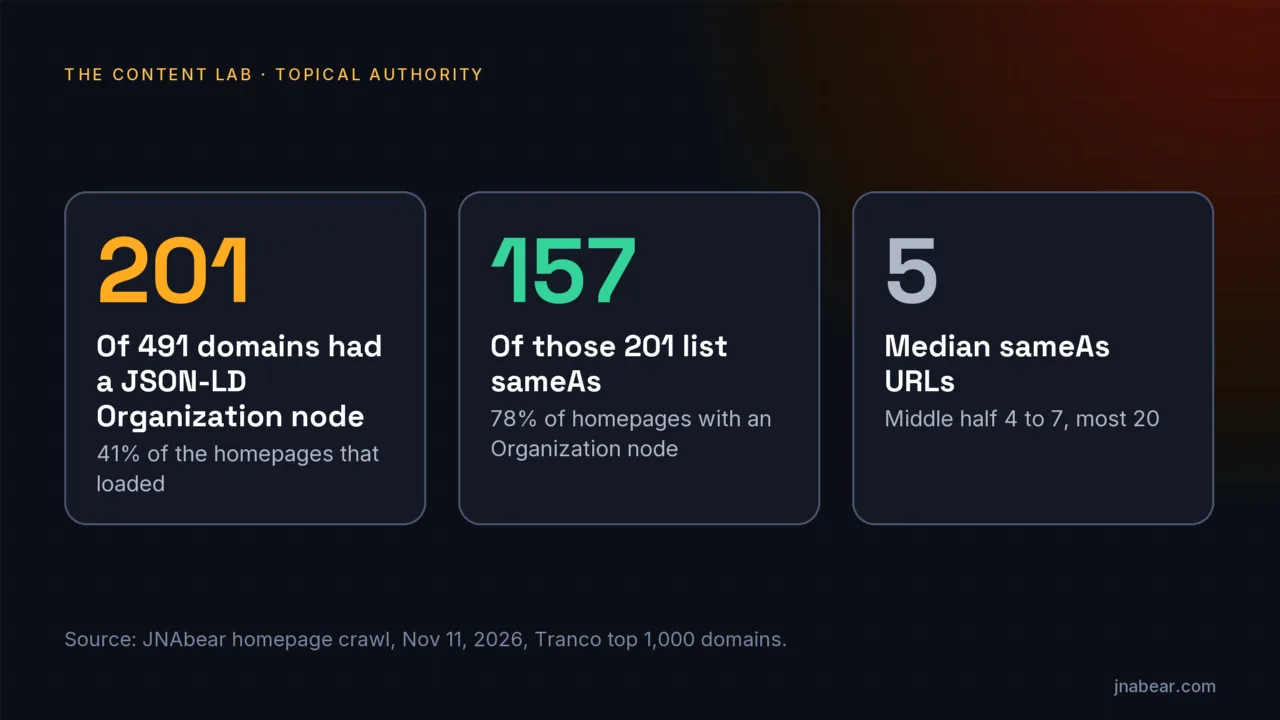
Organization schema sameAs lists the URLs of other pages that identify the same organization, such as its LinkedIn page, its Wikipedia article or its Wikidata item. On Nov 11, 2026, I requested the homepages of the Tranco top 1,000 domains. 491 loaded, 201 of those had a JSON-LD Organization node, and 157 of the 201 gave it sameAs, with a median of 5 URLs. LinkedIn was the most common target.
Key takeaways
- Google's Organization guide (updated Sep 8, 2026) calls sameAs "The URL of a page on another website with additional information about your organization" and says "You can provide multiple sameAs URLs."
- Of the Tranco top 1,000 domains, 491 returned a homepage on Nov 11, 2026. 201 of those 491 (41%) served a JSON-LD Organization or subtype node in their HTML.
- 157 of the 201 (78%) had Organization schema sameAs. The median was 5 URLs, the middle half listed 4 to 7, and the most was 20, on taboola.com.
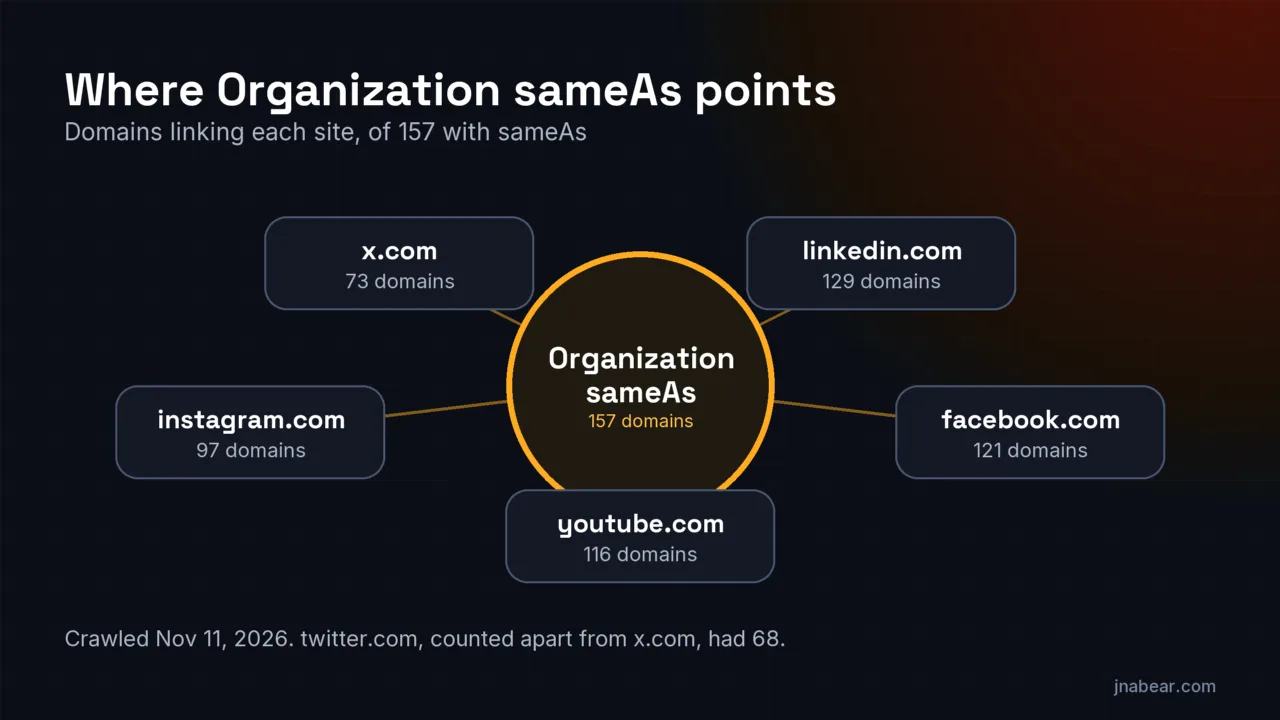
- Top targets among the 157 domains: linkedin.com 129, facebook.com 121, youtube.com 116, instagram.com 97, x.com 73. Another 68 used twitter.com, and none listed both.
- 63 of the 157 (40%) linked Wikipedia and 34 (22%) linked Wikidata. All 30 Wikidata items existed, and for 30 of the 34 domains the item's official website (P856) matched the site.
- sameAs rarely sits on WebSite or Person nodes: 4 of 157 homepages with a WebSite node and 4 of 29 with a Person node gave those nodes sameAs.
On this page (10)
What is sameAs in Organization schema?
sameAs is a schema.org property that lists the URLs of other pages identifying the same thing. On an Organization node, those URLs are usually the company's own social profiles; fewer link its Wikipedia article or Wikidata item.
Schema.org defines sameAs as the "URL of a reference Web page that unambiguously indicates the item's identity." Its examples are "the URL of the item's Wikipedia page, Wikidata entry, or official website." The property belongs to Thing, the root type, so any node can carry it. Organization is the type for "An organization such as a school, NGO, corporation, club, etc." Put the two together and you get Organization schema sameAs: a list of pages that say the company on this site is the same company described over there.
| Entity | What it is | Its part in sameAs |
|---|---|---|
| Organization | A schema.org type, with 166 more specific classes below it in the version 30.1 vocabulary, counting extension and pending terms but not 21 MedicalSpecialty values that are also subclasses of MedicalBusiness | The node that holds the sameAs list |
| sameAs | A schema.org property whose value is a URL, or a list of URLs | Each URL names one page about the same organization |
| Wikidata item | A numbered entry, such as Q7624104 for Stripe, in the Wikidata knowledge base | A target a machine can check, because the item has structured fields |
| Official website (P856) | The Wikidata property for "URL of the official page of an item" | Links the item back to the domain, so the match can go both ways |
| Wikipedia article | An encyclopedia page about the organization | A target that people and machines both read |
| Social and directory profiles | Pages on LinkedIn, Facebook, YouTube, Instagram, X and others | The most common targets in the crawl below |
Each sameAs value states one fact as subject, predicate and object: the Organization, the sameAs relation, and the URL. That is the same shape every other property in schema markup uses. The guide to entity-based SEO covers where the property fits in the wider job of being recognized. This article is about what real sites actually do with Organization schema sameAs.
What does Google say about sameAs in Organization markup?
Google's Organization structured data guide lists sameAs among its recommended properties, says you can give more than one URL, and describes each one as a page on another website with more information about your organization.
The full entry, as I read it on Nov 11, 2026, in the guide last updated Sep 8, 2026: "The URL of a page on another website with additional information about your organization, if applicable. For example, a URL to your organization's profile page on a social media or review site. You can provide multiple sameAs URLs." The same guide says "There are no required properties," so sameAs is optional, like everything else in the type.
| Question | Google's answer in the Organization guide (read Nov 11, 2026) |
|---|---|
| Where does the markup go? | "We recommend placing this information on your home page, or a single page that describes your organization, for example the about us page." |
| Does every page need it? | "You don't need to include it on every page of your site." |
| Which type should I use? | "We recommend using the most specific schema.org subtype of Organization that matches your organization." |
| Is sameAs required? | No. "There are no required properties." sameAs is in the recommended list. |
| How many sameAs URLs? | "You can provide multiple sameAs URLs." No number is given. |
The guide also explains why the markup exists. It says adding it to your home page "can help Google better understand your organization's administrative details and disambiguate your organization in search results." It names iso6523 and naics as properties used "behind the scenes" for that. It does not name sameAs there, and it makes no promise about what sameAs changes in results. Google's placement advice is why this crawl reads home pages, and why I counted the whole Organization schema sameAs list on that one page.
How many top sites use Organization schema sameAs?
About a third of top-site homepages that loaded carry Organization schema sameAs. On Nov 11, 2026, 491 of the Tranco top 1,000 domains returned a homepage, 201 of those had a JSON-LD Organization node, and 157 of the 201 gave that node sameAs.
| Step (Tranco top 1,000, crawled Nov 11, 2026) | Domains | Share |
|---|---|---|
| Domains in the sample | 1,000 | n/a |
| Skipped: robots.txt disallows the crawler from / | 40 | 4.0% of 1,000 |
| Skipped: robots.txt answered 5xx or 429, treated as disallow | 8 | 0.8% of 1,000 |
| Skipped: robots.txt unreachable (DNS, timeout, TLS or connection error), so the homepage was not requested | 324 | 32.4% of 1,000 |
| Homepage requested, no answer within 20 seconds | 2 | 0.2% of 1,000 |
| Homepage requested, answered with more than 5 redirects | 3 | 0.3% of 1,000 |
| Homepage answered with a status other than 200, mostly 4xx (97 were 403, 23 were 404, 3 were 202) | 132 | 13.2% of 1,000 |
| Homepage fetched with a 200 status | 491 | 49.1% of 1,000 |
| Any JSON-LD block in the served HTML | 245 | 49.9% of 491 |
| A JSON-LD Organization or subtype node | 201 | 40.9% of 491 |
| That node has sameAs | 157 | 78.1% of 201, or 32.0% of 491 |
Most losses at the top of the table are about the list, not about Organization schema sameAs. Tranco ranks domains, not websites, so it includes DNS, CDN and ad-serving domains that never had a homepage. 225 of the 324 unreachable robots.txt files were DNS lookups that found no address for the bare domain. A few company domains did fail at TLS on the bare name: tencent.com and netease.com served a certificate for a different name, and huawei.com's server rejected the handshake. Some domains also land on the same site: the 491 homepages ended on 450 distinct hosts, and the 157 with sameAs on 146.
Most sites used the plain type. Of the 201 homepages with an Organization node, 169 used Organization itself, 23 used Corporation, 21 used NewsMediaOrganization, 3 used OnlineStore, 2 used LocalBusiness and 1 used GovernmentOrganization. A homepage with two types counts under both. 151 of the 201 used only the plain Organization type, though Google recommends the most specific subtype. 44 homepages had more than one Organization node, often a publisher and a parent brand. For those, I counted the node with the longest sameAs list, which can be a sub-brand rather than the site's main node.
Some of the best-known names served no JSON-LD at all in the HTML my crawler received, including microsoft.com, amazon.com, github.com, spotify.com and theguardian.com. That does not mean their pages have no markup. A site can add it with JavaScript, or serve different HTML to a browser. It means the plain HTML had none on Nov 11, 2026.
Organization sameAs crawl, Nov 11, 2026 (CSV)
All 1,000 Tranco domains: fetch outcome, status, final host, robots.txt result, Organization types, sameAs count, hosts and URLs, Wikidata checks, and WebSite and Person sameAs. Final URLs are cut to scheme and host, and the few values that came from a country edition of a page are withheld and marked. Free to reuse with a link to this page.
Which sites do homepages link to in sameAs?
LinkedIn, Facebook and YouTube are the most common targets of Organization schema sameAs on top-site homepages. Of 157 domains with sameAs on Nov 11, 2026, 129 linked linkedin.com, 121 facebook.com and 116 youtube.com.
| Rank | Target site | Domains linking it | Share of 157 |
|---|---|---|---|
| 1 | linkedin.com | 129 | 82.2% |
| 2 | facebook.com | 121 | 77.1% |
| 3 | youtube.com | 116 | 73.9% |
| 4 | instagram.com | 97 | 61.8% |
| 5 | x.com | 73 | 46.5% |
| 6 | twitter.com | 68 | 43.3% |
| 7 | wikipedia.org (any language) | 63 | 40.1% |
| 8 | wikidata.org | 34 | 21.7% |
| 9 | github.com | 28 | 17.8% |
| 10 | tiktok.com | 22 | 14.0% |
A domain counts once per target, however many URLs it lists there. I grouped hosts by site, so www.linkedin.com and de.linkedin.com both count as linkedin.com, and every language edition of Wikipedia counts as wikipedia.org. English Wikipedia alone had 57 of the 63. Below the top ten came crunchbase.com with 13, pinterest.com with 9 and bsky.app with 6.
X and Twitter are one service under two hostnames, and the table keeps them apart because the crawl ranked hosts. Counted together, they would top the list: 141 of the 157 domains linked one or the other. Not one linked both. If your markup still says twitter.com, you have plenty of company.
One irony runs through the top of this list. The robots.txt files at facebook.com, instagram.com, x.com and linkedin.com all disallowed my crawler from the root, so their homepages were skipped. Those rules cover every path, profile pages included, so a link checker that obeys robots.txt cannot test those profile links. I did not check those links. A non-200 answer from a social site is not, by itself, evidence of a broken profile.
How many sameAs URLs does a homepage usually list?
A top-site homepage lists a median of 5 sameAs URLs. Among 157 domains with Organization schema sameAs on Nov 11, 2026, the middle half listed 4 to 7, 3 listed just one, and the longest list had 20, on taboola.com.
| sameAs URLs on the Organization node | Domains (of 157) |
|---|---|
| 1 | 3 |
| 2 | 8 |
| 3 | 23 |
| 4 | 21 |
| 5 | 25 |
| 6 | 27 |
| 7 | 24 |
| 8 | 13 |
| 9 | 6 |
| 10 to 20 | 7 |
The longest Organization schema sameAs lists add reference pages, and sometimes press coverage, on top of the usual profiles. Taboola's 20 include seven language editions of Wikipedia, Wikidata, the employer and career sites Glassdoor, Xing and kununu, and four news articles about the company, on axios.com, elpais.com, mediaweek.com.au and adzine.de. On nbcnews.com, the largest list, 15 URLs across 8 sites, belongs to the NBC Select subOrganization, while the NBC News publisher node lists 8. Stripe lists 12, including Wikipedia, Wikidata, Crunchbase, GitHub and company profiles on Bloomberg and Yahoo Finance. Across all 157 domains there were 878 sameAs URLs. Only 11 used http rather than https.
Nine of the 157 listed at least one URL on their own site or its subdomains, such as a blog, a docs site or a support center. Schema.org gives an "official website" as one example of a sameAs page. Google's guide describes sameAs as "a page on another website." If you want to follow Google's wording, keep your own pages out of the list and use the url property for your site.
Do homepages link Wikidata and Wikipedia in sameAs?
Fewer than half of top-site homepages link Wikipedia or Wikidata in Organization schema sameAs. Of 157 domains with sameAs on Nov 11, 2026, 63 linked a Wikipedia article, 34 a Wikidata item, and 68 at least one of the two.
The Wikidata links were in good shape. The 34 domains linked 30 distinct items, because some sample domains land on the same company's pages: mzstatic.com redirects to apple.com, cookielaw.org to a onetrust.com page, mozilla.com and firefox.com both land on firefox.com, and doubleclick.net and google-analytics.com both carry Google's node. I fetched each item from Wikidata on the same day. All 30 existed. One was a merged item that now redirects: t-online.de links Q90880889, which forwards to Q590940, the item for T-Online. All 30 items carry an official website (P856).
| Wikidata check (Nov 11, 2026) | Result |
|---|---|
| Domains linking Wikidata | 34 of 157 (21.7%) |
| Distinct items linked | 30 |
| Items that exist | 30 of 30 (1 through a redirect to a merged item) |
| Items with an official website (P856) | 30 of 30 |
| Domains whose item's P856 matches the domain or the site it redirects to | 30 of 34 |
| Domains linking a parent company's item instead | 4 of 34 |
| Link format | 32 used /wiki/Q..., 2 used /entity/Q... |
The four that did not match look deliberate: each links the parent brand's item. doubleclick.net and google-analytics.com redirect to Google Marketing Platform pages and link Google's item, Q95, whose official website is about.google. mozilla.com and firefox.com both land on firefox.com and link Mozilla's item, Q9661, whose official website is mozilla.org. Apple shows the other format: its sameAs uses the entity URI, http://www.wikidata.org/entity/Q312, and that item's P856 list includes apple.com. Both formats name the same item.
A Wikidata item is where many tools connect a site to the wider knowledge graph, and P856 is the field that points back. If your organization has an item, check that its official website matches your domain before you add the item to your Organization schema sameAs. In my judgment, a missing item is no reason to make one just for markup: about three in four of these top sites did not link one.
Do WebSite and Person nodes carry sameAs too?
Top-site homepages rarely give WebSite or Person nodes sameAs. On Nov 11, 2026, 157 of 491 homepages had a WebSite node and 4 gave that node sameAs. 29 had a Person node, and 4 of those 29 gave it sameAs.
Homepages put their identity links in Organization schema sameAs, not on the node for the website. Person nodes were uncommon on homepages, which makes sense for large companies. A founder-led business is different: the person behind it is often the entity people search for, and an About page with a Person node is the natural home for that person's sameAs.
What does a small site's Organization schema sameAs look like?
This site, jnabear.com, is one small-site example, and its Organization schema sameAs holds one URL. On Nov 11, 2026, the homepage's Organization node listed the JNAbear LinkedIn company page, and its Person node for Joseph Nicholas Abear listed one LinkedIn profile.
That is one data point, not a benchmark. This site is not in the Tranco top 1,000, so it sits outside the sample. Both lists come from the site's code, which reads the two LinkedIn URLs from its settings, so every page uses the same URL, and there is one setting to update if a profile changes. The WebSite node has no sameAs, like 153 of the 157 in the crawl. There is no Wikipedia or Wikidata link. Against the crawl, where the median was 5, one URL is short.
To check what your own homepage declares, this site's free Entity SEO Analyzer lists the structured data types a page carries. Read the sameAs list itself in the JSON-LD.
How do you write Organization schema sameAs for your own site?
List the profiles your organization runs and the reference pages about it, as full https URLs, on the Organization node of your home page. Add Wikipedia and Wikidata only when a page about your organization exists.
- Put the Organization schema sameAs markup on the home page or one About page. Google says you do not need it on every page.
- Use the most specific type that fits, as Google recommends: OnlineStore for a shop, NewsMediaOrganization for a publisher, LocalBusiness or one of its subtypes for a local firm.
- Start with the profiles you actually run. In the crawl, LinkedIn, Facebook, YouTube, Instagram and X or Twitter were the five most common targets.
- Use one URL per profile, in its full https form. 11 of the 878 URLs in the crawl still used http.
- Add a Wikidata item only if it is about your organization and its official website (P856) is your domain. Add a Wikipedia article only if one exists about you.
- Leave your own pages out of sameAs if you follow Google's wording, "a page on another website." Use url for your site.
- Check each profile by hand in a browser. The robots.txt files of Facebook, Instagram, X and LinkedIn disallow all unnamed bots, so a link checker that obeys robots.txt skips those profiles.
<script type="application/ld+json">
{
  "@context": "https://schema.org",
  "@type": "Organization",
  "@id": "https://www.example.com/#organization",
  "name": "Example Widgets",
  "url": "https://www.example.com/",
  "logo": "https://www.example.com/logo.png",
  "sameAs": [
    "https://www.linkedin.com/company/example-widgets/",
    "https://www.facebook.com/examplewidgets",
    "https://www.youtube.com/@examplewidgets",
    "https://www.instagram.com/examplewidgets/",
    "https://x.com/examplewidgets"
  ]
}
</script>
The example is fictional, and its five profiles mirror the five most common targets in the crawl. A real list should hold only the profiles your business has. Give the node an @id, as above, so your WebPage, Article and Person nodes can point at it rather than repeat it. That keeps one Organization schema sameAs list on the site, and one place to update when a profile changes.
How do you measure Organization sameAs usage across top sites?
I requested the https homepage of each of the Tranco top 1,000 domains once on Nov 11, 2026, with the same user agent as this site's crawler checker, obeying robots.txt rules, following up to 5 redirects, with a 20 second timeout and no JavaScript rendering.
The sample is the top 1,000 domains of Tranco list Y895G, generated on Nov 10, 2026. Tranco built it from CrUX, Farsight, Majestic, Radar and Umbrella data for Oct 12 to Nov 10, 2026. I wrote the 1,000 domains to a file before fetching any homepage, and made no swaps. Each request used the user agent JNAbear-AICrawlerCheck/1.0, the one the AI Crawler Checker sends. It never imitates Googlebot or a browser. Eight domains were requested at a time. Every count is per Tranco domain, and a few domains land on the same page, such as mzstatic.com on apple.com, so the 157 domains with sameAs ended on 146 distinct hosts.
Before each request, I read robots.txt for every host in the redirect chain. A site was skipped if its rules disallowed my crawler, or all crawlers, from the root path. When robots.txt is unreachable because of server or network errors, RFC 9309 says "the crawler MUST assume complete disallow." Six sites answered robots.txt with a server error. Two more answered 429, Too Many Requests, and I skipped those too, the cautious reading. For 324 domains, robots.txt could not be reached at all, because of a DNS, timeout, TLS or connection error, and the homepage was not requested either. Any other 4xx answer for robots.txt counted as no rules.
The first pass checked TLS certificates against a bundle of 128 root certificates that lacked some current roots, so some sites failed for that reason alone. Later the same day, I re-requested the 46 domains that had failed at TLS, with the 158 roots of the macOS system store added. 15 of them then answered, and every count here includes them. Of the 31 that still failed, 17 served a certificate for a different name, 11 failed or timed out in the TLS handshake, 2 had a certificate chain that still did not verify, and 1 reset the connection.
In each homepage, I parsed every application/ld+json block in the HTML the server sent, and walked @graph lists and nested nodes. Microdata and RDFa were not parsed, so Organization markup in those formats is not counted. A node counted as an Organization if its type was Organization or one of the 166 classes below it in the schema.org version 30.1 vocabulary, released Sep 16, 2026, counting extension and pending terms. The vocabulary also places 21 MedicalSpecialty values, such as Dermatology, under MedicalBusiness. They were not in the type list, and no homepage in the crawl used one. Nodes sharing an @id were merged. On a page with more than one Organization node, I counted the one with the longest sameAs list, so the counted node can be a subOrganization, as on nbcnews.com. One homepage had a block that would not parse as JSON. Google documents ways to generate structured data with JavaScript, including Google Tag Manager, and markup added that way is invisible to a crawl that does not render pages. So these counts describe JSON-LD in served HTML, and they are a floor.
I did not request any sameAs URL except on Wikidata. Each Wikidata item came from its Special:EntityData JSON page, one request every half second. Wikidata's robots.txt allows those pages and disallows the /w/ path, where its API lives. Ten adult domains in the sample are flagged in the CSV and kept in every count, but left out of named examples. I found no gambling domain in the sample by name or by a Casino type. Results can differ by country, by user agent and by day. 97 homepages answered with a 403, which often points to a bot rule rather than a missing page.
Sources
- Google Search Central: Organization structured data (updated Sep 8, 2026) (opens in a new tab) (verified Nov 2026)
- Schema.org: sameAs (opens in a new tab) (verified Nov 2026)
- Schema.org: Organization (opens in a new tab) (verified Nov 2026)
- Schema.org: Releases (version 30.1, Sep 16, 2026) (opens in a new tab) (verified Nov 2026)
- Tranco: list Y895G (generated Nov 10, 2026) (opens in a new tab) (verified Nov 2026)
- Wikidata: Property P856, official website (opens in a new tab) (verified Nov 2026)
- Google Search Central: Generate structured data with JavaScript (updated Dec 10, 2025) (opens in a new tab) (verified Nov 2026)
- RFC 9309: Robots Exclusion Protocol (opens in a new tab) (verified Nov 2026)
Topics & entities in this article
Frequently asked questions
No. Google's Organization guide says "There are no required properties," and lists sameAs as recommended. In a Nov 11, 2026 crawl of the Tranco top 1,000 domains, 157 of 201 domains whose homepage had a JSON-LD Organization node included sameAs, and 44 did not.
No rule sets a number. Google says "You can provide multiple sameAs URLs." Among 157 top domains whose homepage had Organization schema sameAs on Nov 11, 2026, the median was 5, the middle half listed 4 to 7, and the most was 20.
Only if a Wikidata item about the organization exists and its official website (P856) is your domain. On Nov 11, 2026, 34 of 157 top domains with Organization schema sameAs linked Wikidata, and for 30 of the 34 the item's P856 matched the site.
In a Nov 11, 2026 crawl, 157 top domains had Organization schema sameAs on their homepage. linkedin.com appeared on 129, facebook.com on 121, youtube.com on 116, instagram.com on 97 and x.com on 73. Counted together, x.com and twitter.com appeared on 141.
Schema.org lists an official website as one example of a sameAs page, but Google's Organization guide describes sameAs as "a page on another website." Use the url property for your own site. In a Nov 11, 2026 crawl, 9 of 157 top domains with sameAs listed their own pages.
No. Google's Organization guide says "You don't need to include it on every page of your site" and recommends the home page or a single page about the organization, such as an About page.
They can, since sameAs is defined on Thing, but top-site homepages rarely do it. On Nov 11, 2026, 4 of 157 domains whose homepage had a WebSite node and 4 of 29 with a Person node gave those nodes sameAs.
Related service
Topical Authority Mapping
Topical authority mapping is an entity-based plan of every pillar, cluster, and content gap your site needs to cover a topic, for SaaS companies, publishers, and businesses in competitive niches.
Disclosure: this is a service I sell.