Quick answer
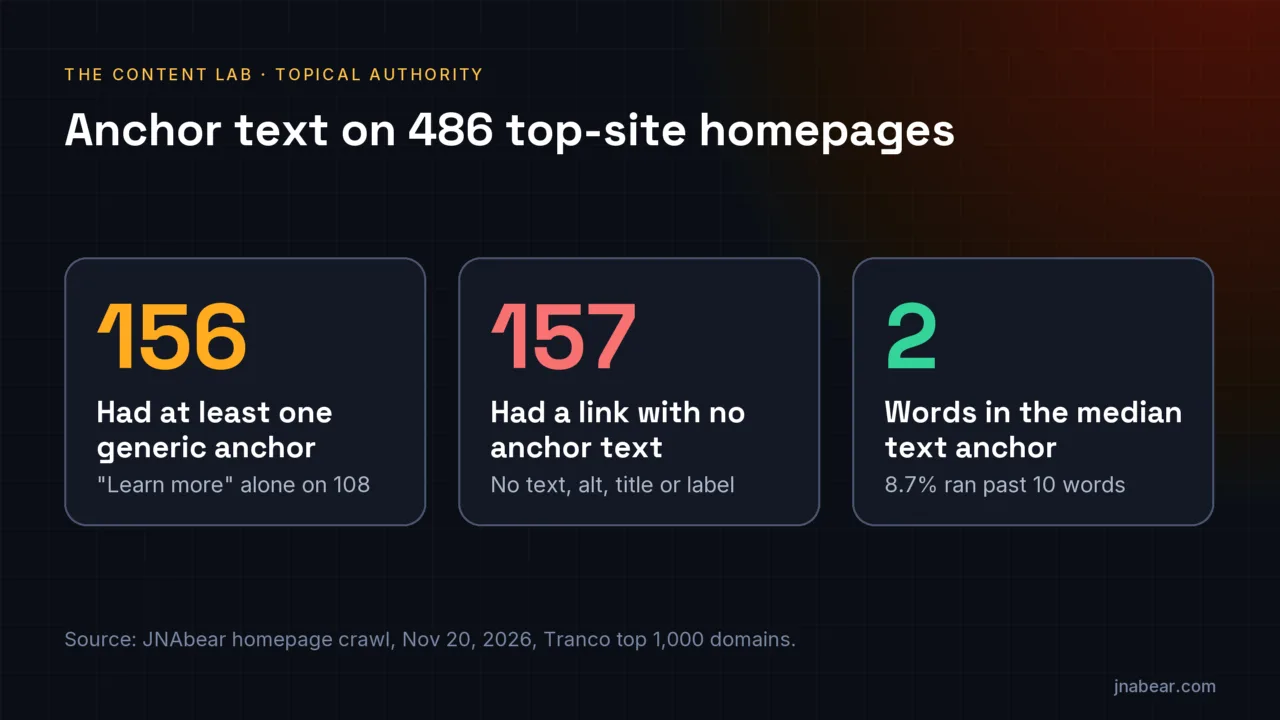
Anchor text is the visible text of a link, the words a reader clicks. Google calls it link text and says it "tells people and Google something about the page you're linking to." A JNAbear crawl on Nov 20, 2026 counted 73,327 links on 486 top-site homepages: 91.8% had visible text, 1.9% had no anchor text at all, and 156 homepages used at least one generic anchor such as "Learn more".
Key takeaways
- Google's "Link best practices for Google" page (last updated Dec 10, 2025, read Nov 20, 2026) defines anchor text as "the visible text of a link" and says good link text is "descriptive, reasonably concise, and relevant."
- Google can use the title attribute as anchor text "if the <a> element is for some reason empty," and uses the alt attribute for image links. The page does not mention aria-label.
- Of the Tranco top 1,000 domains, 486 returned a homepage on Nov 20, 2026. Their 73,327 crawlable links used visible text 91.8% of the time, image alt text 3.7%, a title attribute only 0.8%, and an aria-label only 1.8%.
- 1,375 links (1.9%) had no anchor text by any of those routes. 157 of the 486 homepages (32.3%) had at least one.
- 881 links (1.2%) used generic text from Lighthouse's English list or Google's examples, on 156 homepages (32.1%). "Learn more" was 676 of the 881, on 108 homepages.
- The median text anchor was 2 words. 8.7% ran past 10 words, mostly news headlines, some joined in one link with a section name or a summary.
- On jnabear.com, before this article was added, the same check found 6,396 internal links across 123 URLs, none generic and none empty, but 221 whole-card links whose text runs from the category name through the summary.
On this page (10)
What is anchor text in SEO?
Anchor text is the visible, clickable text of a link. Google calls it link text and says it tells people and Google something about the page being linked to. In HTML, it is whatever sits between the opening <a href> tag and the closing </a> tag of a hyperlink.
Google Search Central's "Link best practices for Google" page puts it in one line: "Anchor text (also known as link text) is the visible text of a link." The same page says Google uses links "as a signal when determining the relevancy of pages and to find new pages to crawl." So the words in a link do two jobs at once. They tell a reader what is behind the link, and they tell Google something about the page it points to.
<!-- The anchor text here is "list of cheese types" -->
<a href="https://example.com/cheese">list of cheese types</a>

<!-- An image link: Google reads the alt text as the anchor text -->
<a href="/add-to-cart.html"><img src="enchiladas.jpg" alt="add enchiladas to your cart"></a>
Both examples are adapted from Google's page. The rest of this article uses the terms in the table below, and each row names how the thing relates to a link's text.
| Entity | What it is | Its relation to the link's text |
|---|---|---|
| Hyperlink (the <a> element) | The HTML element that makes a link, with the target in its href attribute | Holds the text. Google says it can "generally" crawl a link only if it is an <a> element with an href. |
| Alt text | The alt attribute of an img element | Google uses it as the anchor of an image link. |
| Title attribute | An optional attribute on the <a> element | Google's fallback when the link has no text. |
| aria-label | An accessibility attribute that names an element for screen readers | Not mentioned on Google's link page, so its use there is undocumented. |
| nofollow | A rel value that qualifies a link | Google says to use it "only when you don't trust the source," and for paid or user-added links. |
| Internal linking | Links between pages of the same site | Google says the text of internal links helps people and Google "make sense of your site more easily." |
| Orphan page | A page that no other page on the site links to | Gets no internal link text at all. Google: "Every page you care about should have a link from at least one other page on your site." |
| Keyword stuffing | Cramming keywords into text to manipulate ranking | Google warns against it in links and calls it "a violation of our spam policies." |
What does Google say makes good anchor text?
Google says good anchor text is descriptive, reasonably concise, and relevant to both the page it sits on and the page it links to. Its link guide marks generic text, empty links, very long links and links chained word by word as bad examples, and warns against cramming keywords into links.
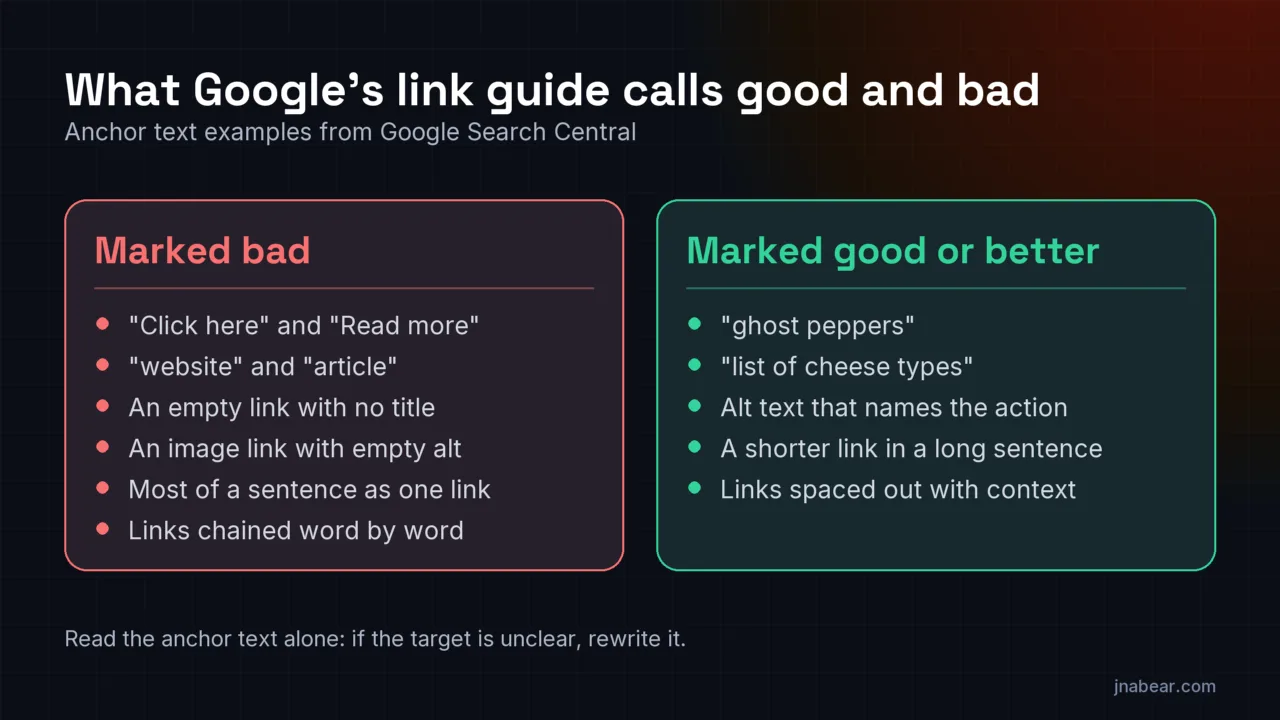
The full page was read on Nov 20, 2026. It shows "Last updated 2025-12-10 UTC." These are its rules on link text, quoted where the wording matters.
| Question | What Google's link page says (read Nov 20, 2026) |
|---|---|
| What is anchor text? | "The visible text of a link." Google also calls it link text. |
| What makes it good? | "Good anchor text is descriptive, reasonably concise, and relevant to the page that it's on and to the page it links to." |
| Which examples are too generic? | "Click here", "Read more", "website" and "article", each shown as the whole link. |
| What if the link has no text? | Google "can use the title attribute as anchor text if the <a> element is for some reason empty." An empty link with no title is marked bad. |
| What about image links? | Google "uses the alt attribute of the img element as anchor text." An image link with empty alt text and no link text is marked bad. |
| How long should it be? | No number. A link covering most of a sentence is labeled "weirdly long", and the better version links only the opening words of that phrase, "Knitted Cow invites local residents of Wisconsin". |
| Can I add keywords? | "Resist the urge to cram every keyword that's related to the page that you're linking to." |
| How many links per page? | "There's no magical ideal number of links a given page should contain." |
Google also offers a test you can run by eye: "Try reading only the anchor text (out of context) and check if it's specific enough to make sense by itself." It adds that the words around a link matter too, and that links placed next to each other with no text between them are harder to tell apart. That last rule is about readers as much as crawlers.
Lighthouse, Google's open-source page auditing tool, turns part of this into a pass or fail check called "Links have descriptive text." Its source code lists 14 English phrases it flags: click here, click this, go, here, information, learn more, more, more info, more information, right here, read more, see more, start and this. It also holds lists for other languages. It skips nofollow links, javascript: and mailto: links, and links back to the same page. The count below uses the English list.
What are the types of anchor text?
SEO writers usually sort anchor text into descriptive, exact-match, partial-match, branded, naked URL, generic, image and empty types. These labels are industry shorthand that Google does not use. Google's link page judges each link by whether its words describe the target, whatever the type.
| Type | Example (for a page about pickling ghost peppers) | How Google's link page treats it |
|---|---|---|
| Descriptive | how to pickle ghost peppers | This is the pattern Google calls good: it says what the page is. |
| Exact-match | pickled ghost peppers (the page's target phrase, word for word) | Fine when natural. Google warns against cramming keywords in. |
| Partial-match | our ghost pepper pickling notes | A form of descriptive text. |
| Branded | Example Farms | Names the site. Fine when the link is about the brand. |
| Naked URL | example.com/ghost-pepper-recipe | Not covered on the link page. Lighthouse's help page says to avoid it "unless you have a good reason." |
| Generic | click here, read more, learn more | "Click here" and "Read more" are Google's own "too generic" examples. |
| Image | An img with alt="how to pickle ghost peppers" | Google reads the alt text as the link's text. |
| Empty | A link with no text, no alt and no title | Marked bad. Google has nothing to read. |
The examples are made up for illustration, built on Google's own ghost pepper example. A natural link profile mixes several of these types. Branded and naked URL anchors are common in links other sites give you, and you do not control those. You do control the words on your own pages, which is where internal linking and the rules above apply.
Links placed on other sites carry a separate risk. Google's spam policies page (last updated Aug 28, 2026, read Nov 20, 2026) lists "links with optimized anchor text in articles, guest posts, or press releases distributed on other sites" as an example of link spam. Keyword-heavy anchors in placed links are a policy problem as well as a style problem.
What anchor text do top homepages actually use?
Top homepages mostly use short visible text. On Nov 20, 2026, 486 of the Tranco top 1,000 domains returned a homepage, holding 73,327 crawlable links. 91.8% of those links had visible text as their anchor text, the median text anchor was 2 words, and 1.9% of links had nothing to read.
| Where the link's text came from (73,327 links on 486 homepages) | Links | Share | Homepages with at least one |
|---|---|---|---|
| Visible text inside the link | 67,331 | 91.8% | n/a |
| No text, but an image with alt text | 2,717 | 3.7% | 239 (49.2%) |
| No text or alt, but a title attribute | 595 | 0.8% | 85 (17.5%) |
| Only an aria-label | 1,309 | 1.8% | 202 (41.6%) |
| Nothing: no text, alt, title or aria-label | 1,375 | 1.9% | 157 (32.3%) |
Visible text comes first, as on Google's page. Google names alt text for image links and the title attribute as a fallback for an empty link, but sets no order between the two, so where a link had both, this count took the alt text first. The aria-label row is the one Google's page says nothing about. Apple, Stripe and Cloudflare each had one link named only by an aria-label, and in the AI agent's spot check each was an icon link. Those 1,309 links have a name for screen readers but nothing Google's link page lists as anchor text. Of the 1,375 empty links, 759 wrapped an image with empty or missing alt text. The other 616 held no img element: 180 held an inline SVG, 67 an icon-font element, and 369 nothing visual in the HTML.
Some empty links are not what they seem. A site can fill a link with text through JavaScript, or show an image through CSS, and this crawl did not run either, nor check what a browser shows. So the empty count is an upper bound for what a browser shows, and a fair count of what plain HTML gives a crawler.
Length was rarely a problem. The median text anchor was 2 words. 5,849 of 67,331 text anchors (8.7%) ran past 10 words, a threshold set for this count, since Google sets none. 229 homepages had at least one. In a random sample of 25 long anchors, about 17 were news headlines, and some joined in one link with a section name or a summary. A long headline still describes its story, so length alone is not a fault. The cases closer to Google's "weirdly long" example were cards that put a headline, a summary and a call to action inside one link. Stripe's homepage had several, each joining a customer headline with a "Read" line about that customer.
Anchor text on top-site homepages, Nov 20, 2026: totals (CSV)
Totals for the whole sample: the fetch funnel, link counts by type, landmark and source, the generic phrases, per-homepage medians and the most common anchors. It has no per-domain rows, URLs or anchor texts. Free to reuse with a link to this page.
How common is generic anchor text like "click here" or "learn more"?
Generic anchor text is rare per link but common per site. On Nov 20, 2026, 881 of 73,327 links (1.2%) on 486 top-site homepages used a generic phrase as their whole text, yet 156 homepages (32.1%) had at least one. "Learn more" alone made up 676 of the 881.
| Generic phrase (the link's whole text) | Links | Homepages using it |
|---|---|---|
| learn more | 676 | 108 |
| read more | 130 | 30 |
| more | 23 | 12 |
| see more | 17 | 6 |
| here | 13 | 10 |
| click here | 6 | 4 |
| more info | 5 | 3 |
| start | 4 | 3 |
| more information | 3 | 2 |
| website | 2 | 2 |
| go | 1 | 1 |
| right here | 1 | 1 |
A link counted as generic when its whole text, lowercased with punctuation and arrows removed, matched one of Lighthouse's 14 English phrases or Google's other two examples, "website" and "article." No link used "article", "click this", "information" or "this" alone. The 108 homepages that used "Learn more" averaged about 6 such links each. That is the pattern Google's page warns about: read out of context, identical anchors say nothing about the different pages behind them.
Lighthouse's own check is stricter in one way: one matching link fails the page. Applying that rule to the served HTML, using only Lighthouse's English list and counting only followed links to another URL with an exact match, 141 of the 486 homepages (29.0%) would fail. Lighthouse itself also checks other languages' lists, so it would likely flag more of the non-English homepages. The HTTP Archive's 2025 Web Almanac, which ran Lighthouse across its own much larger crawl, reported that 84.64% of desktop homepages and 86.64% of mobile homepages passed. The two numbers come from different samples and methods, so they do not form a trend.
Where do homepage links sit: menus, footers or body text?
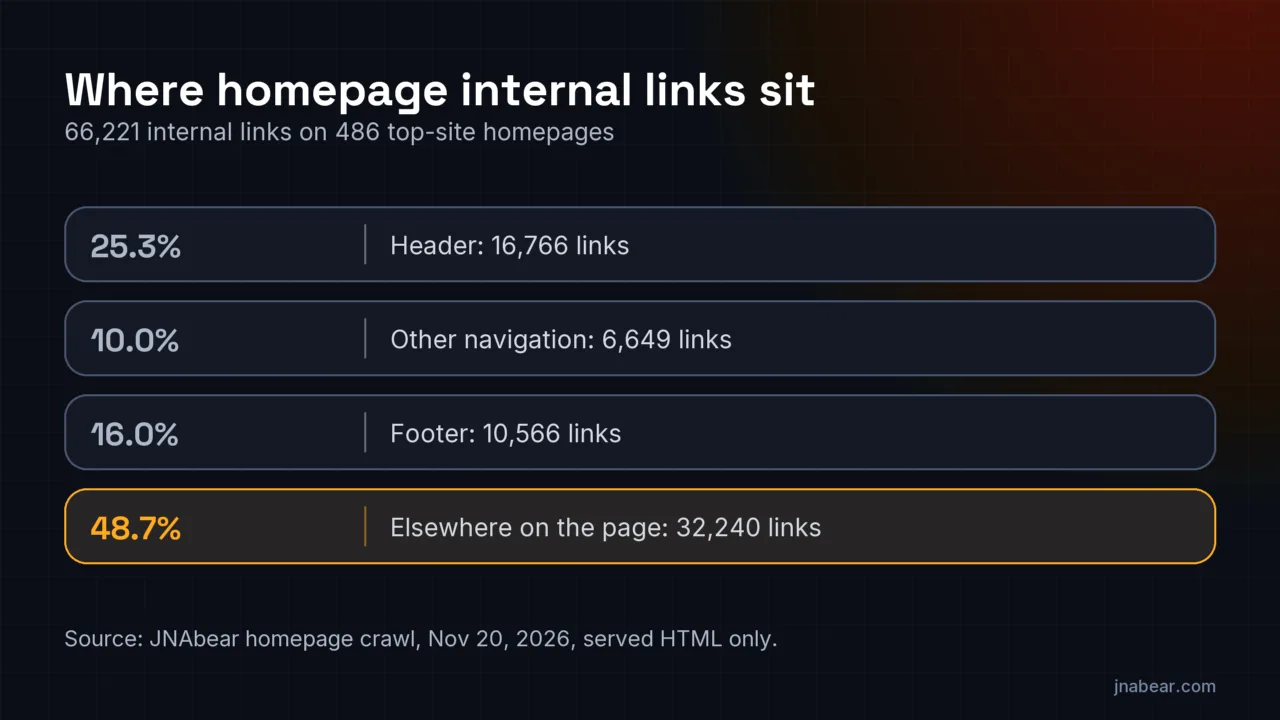
About half of the internal links on top-site homepages sit in menus, headers and footers, where the anchor text usually repeats site-wide. Of 66,221 internal links on 486 homepages crawled Nov 20, 2026, 51.3% were inside a header, navigation or footer landmark, and 48.7% sat elsewhere.
| Landmark (HTML element or ARIA role) | Internal links | Share | External links | Share |
|---|---|---|---|---|
| Header (banner) | 16,766 | 25.3% | 866 | 12.2% |
| Navigation outside the header and footer | 6,649 | 10.0% | 303 | 4.3% |
| Footer (contentinfo) | 10,566 | 16.0% | 2,480 | 34.9% |
| Elsewhere on the page | 32,240 | 48.7% | 3,457 | 48.6% |
| Total | 66,221 | 100% | 7,106 | 100% |
90.3% of the links were internal, pointing at the same registered domain. The median homepage had 94 internal links, with the middle half between about 23 and 175, and 9 external links. The median homepage put 24 internal links outside its header, navigation and footer. Wikipedia's portal shows how far the split can lean: 358 of its 359 internal links sat inside two navigation elements that list its language editions.
This split matters because menu and footer anchors usually repeat site-wide and are short by design: "Pricing", "Careers", "Contact us". Body links are where descriptive text has room. Counted by the number of homepages using them, the most common anchors were privacy policy (174 homepages), careers (167), blog (148), contact us (133), privacy (113) and learn more (108). Only the last of those is generic, and it is also the one that lives in the page body: 594 of the 676 "Learn more" links, and 777 of all 881 generic links, sat outside the header, navigation and footer. Footer links such as "Privacy policy" are short, but they name their target.
The HTTP Archive's 2024 Web Almanac reported a median of 129 links to the same site for the top 1,000 sites, by its own ranking and crawl of home pages and inner pages (the chapter gives 129 for both desktop and mobile). This crawl's median of 94 comes from served HTML on homepages only, so it misses links added by JavaScript. 62 homepages in this crawl served fewer than 5 crawlable links before any script ran. Neither number is a target. Google's page says there is no ideal number.
Can Google read links that have no href?
Not reliably. Google says it can generally crawl a link only if it is an <a> element with an href attribute, and that javascript: URLs are not recommended. On Nov 20, 2026, 114 of 486 top-site homepages had at least one <a> without an href, and 51 used a javascript: href.
The counts are small per link: 649 of 76,201 <a> elements had no href, and 326 used javascript:. In a random sample of 25 of the 649 links with no href, 12 had no visible text, and about half of the rest were short menu labels such as "Platform" or "About Us", which suggests controls that open a menu or panel through JavaScript. That is a problem only if a page can be reached through such controls alone. A further 1,756 links pointed only at a fragment, like #top, which moves within the same page.
nofollow was uncommon. 1,308 of 73,327 links (1.8%) carried rel="nofollow", on 75 homepages (15.4%). 6.3% of external links had it. sponsored appeared on 11 links across 4 homepages, and ugc on 26 links across 2.
What does anchor text look like on a small site?
On jnabear.com, a small site outside the Tranco sample, the same code found 6,396 internal links across 123 sitemap URLs on Nov 20, 2026, before this article was added. All had visible text, none matched the generic list, and none was empty. The weak spot was 221 card links with very long text.
Every sitemap URL of the site's code was rendered locally and run through the same counting code. The main menu holds 16 internal links and the footer 17, on every page, so 4,059 of the 6,396 internal links (63.5%) repeat site-wide. The other 2,337 sit in breadcrumbs, article bodies, related-post cards and the cross-links between articles and glossary terms. No sitemap URL is an orphan page: each one gets at least one link from another page, and every URL is within 2 clicks of the home page. Those cross-links follow the topic cluster pattern, where a pillar page links to each of its cluster pages and each links back. Those links sit in body text, which is the place to use descriptive anchors that name the subtopic.
| jnabear.com internal links (local render, Nov 20, 2026, before this article) | Result |
|---|---|
| Sitemap URLs | 123 |
| Internal links | 6,396 |
| In the main menu and footer | 4,059 (16 and 17 per page) |
| Elsewhere on the page | 2,337 |
| Generic or empty anchors | 0 |
| Inbound links per article, outside the menu and footer | Median 14.5, lowest 7, highest 40 (48 articles) |
| Inbound links per glossary term, same count | Median 12, lowest 4, highest 43 (48 terms) |
| Pages more than 2 clicks from home | 0 |
| Anchors over 10 words | 552: 221 article cards, 150 other cards and labeled links, 181 full titles |
The 221 card links are the finding worth acting on. Each article card is one big link, so its text runs from the category name and read time through the title, the summary and the date to the word "Read." That is close to the "weirdly long" pattern on Google's page. The usual fix is to make only the title the link and let the rest of the card stay plain text, while keeping the whole card clickable with CSS. Of the other 331, 181 are full article or term titles of 11 words or more, which describe the target as Google asks. The remaining 150 are service, tool and term cards, or a title followed by a label such as "Article". They are shorter than the article cards, but the same title-only fix applies. These figures describe the site before this article went up, and changes to cards or menus will shift them.
How do you write good anchor text?
Write anchor text that names what the reader will get, in a few words, inside a sentence that would make sense without the link. Use alt text on image links, space links out with words between them, and check the page by reading only its links.
- Read only the linked words, out of context, as Google suggests. If you cannot tell what the target page is about, rewrite them.
- Replace "Learn more" and "Read more" with the thing itself: "pricing for content audits", "our returns policy". On the homepages crawled, "Learn more" alone was 676 links.
- On a card, make the title the link instead of the whole card, so the anchor is the title and not a summary paragraph.
- Give every image link alt text that describes the target. 759 links in the crawl wrapped an image with empty or missing alt text and nothing else.
- Do not rely on aria-label alone for links you want crawled. It helps screen readers, and Google's link page does not mention it.
- Use real <a href> links for anything that leads to a page, not javascript: or click handlers on other elements.
- Vary internal anchors naturally. Exact-match anchors are fine when they read naturally, and stuffing keywords into them is a spam policy problem.
- Make sure every page you care about gets at least one internal link with descriptive words, so none is an orphan.
<!-- Generic: the anchor says nothing out of context -->
<p>We audit content for small businesses. <a href="/services/content-audits">Learn more</a></p>

<!-- Descriptive: the anchor names the target -->
<p>See what a <a href="/services/content-audits">content audit for a small business</a> covers.</p>
The example is illustrative. For a whole site, a crawl that exports every link with its text is the practical way to find generic and empty anchors at scale. The content audit template on this site has an "Internal links in" column for tracking how many links reach each page. If you would rather have it done, my Content Audits service includes on-page and internal-linking fixes. Disclosure: I sell that service, so weigh my view. If your site is small and the checklist above finds nothing, you do not need it. My free AI Search Visibility Audit, also a JNAbear offer, is a lighter first look.
How was this anchor text crawl measured?
JNAbear's crawler, run by an AI agent, requested the https homepage of each of the Tranco top 1,000 domains once on Nov 20, 2026, with the same user agent as this site's crawler checker, obeying robots.txt for every URL in the redirect chain, following up to 5 redirects, with a 20 second timeout and no JavaScript.
The sample is the top 1,000 domains of Tranco list Y895G, generated on Nov 10, 2026, the same fixed list used for this site's Nov 11 study of Organization schema sameAs. Each request sent the user agent JNAbear-AICrawlerCheck/1.0, the one the AI Crawler Checker uses, and never imitated Googlebot or a browser. Eight domains were requested at a time. When robots.txt answered with a 5xx status or could not be reached at all, the homepage was not requested, following RFC 9309's rule to assume complete disallow in that case. A 429 answer was also treated as a stop, which is stricter than the RFC. Any other 4xx answer for robots.txt counted as no rules. When robots.txt itself redirected more than 5 times, it also counted as no rules, which RFC 9309 allows. That happened on 2 domains, and both homepages then redirected more than 5 times too.
| Step (Tranco top 1,000, Nov 20, 2026) | Domains |
|---|---|
| Skipped: robots.txt disallows the crawler | 42 |
| Skipped: robots.txt answered 5xx (5) or 429 (2) | 7 |
| Skipped: robots.txt unreachable (225 DNS, 51 timeout, 28 TLS, 14 connection, 2 other) | 320 |
| Homepage request timed out | 1 |
| Homepage redirected more than 5 times | 3 |
| Status other than 200 (100 were 403, 24 were 404) | 137 |
| Not an HTML page | 4 |
| Homepage fetched as HTML with a 200 status | 486 |
Most losses come from the list itself. Tranco ranks domains, so it includes CDN, DNS and ad-serving domains with no homepage. In each homepage, JNAbear's own parser read every <a> element in the served HTML, skipping those inside <template> elements. A link counted as crawlable when its href resolved to an http or https URL. Internal means the same registered domain as the final homepage, worked out with a short list of country second-level suffixes such as co.uk rather than the full Public Suffix List. Landmarks follow the HTML accessibility mapping: a header or footer counts only when it is not inside an article, aside, main, nav or section element, and role="banner", "navigation" and "contentinfo" count too. Ancestors with an ARIA role such as main or region were not considered when scoping a header or footer. The link's text is the element's text in the HTML, which can include text hidden with CSS.
Results can differ by country, user agent and day. Many homepages adapt their content to the visitor's country, sometimes at the same URL, so the counts for any one site, including the named examples above, describe one edition of that page. The CSV holds totals only, because a list of which domains blocked, failed or localized a homepage can hint at where a crawl ran. It gives the totals behind every crawl figure in this article. The spot-check samples and named examples come from the raw HTML, which is not published. The crawl, the counting code and the spot checks of long, empty and no-href links were done by an AI agent (Claude) working for this site, and no person has re-read those samples. Ten adult domains in the sample are left out of named examples.
Sources
- Google Search Central: Link best practices for Google (updated Dec 10, 2025) (opens in a new tab) (verified Nov 2026)
- Google Search Central: Spam policies for Google web search, link spam (updated Aug 28, 2026) (opens in a new tab) (verified Nov 2026)
- Chrome for Developers: Links do not have descriptive text (Lighthouse audit) (opens in a new tab) (verified Nov 2026)
- Lighthouse source: link-text audit and its phrase lists (opens in a new tab) (verified Nov 2026)
- HTTP Archive: Web Almanac 2025, SEO chapter (descriptive link text pass rates) (opens in a new tab) (verified Nov 2026)
- HTTP Archive: Web Almanac 2024, SEO chapter (internal links for the top 1,000 sites) (opens in a new tab) (verified Nov 2026)
- Tranco: list Y895G (generated Nov 10, 2026) (opens in a new tab) (verified Nov 2026)
- RFC 9309: Robots Exclusion Protocol (opens in a new tab) (verified Nov 2026)
- W3C: HTML Accessibility API Mappings, Working Draft of Oct 26, 2026 (header and footer landmarks) (opens in a new tab) (verified Nov 2026)
- Wikidata: anchor text (Q362007) (opens in a new tab) (verified Nov 2026)
Topics & entities in this article
Frequently asked questions
Anchor text is the clickable text of a link. In a link that reads "see our pricing", those three words are the anchor text. Google calls it link text and uses it to understand the page the link points to.
Google's own example is "list of cheese types," in the sentence "For a full list of cheese available for purchase, see the list of cheese types." It is short, says what the target page holds, and makes sense when read alone.
Google lists "Click here" as too generic, and Lighthouse flags it. On Nov 20, 2026, only 6 of 73,327 links on 486 top-site homepages used it. "Learn more" was far more common: 676 links on 108 homepages.
Yes, for image links. Google's link page says it "uses the alt attribute of the img element as anchor text." An image link with empty alt text and no other text gives Google nothing to read.
Google sets no length. It asks for "reasonably concise" text and shows a link that covers most of a sentence as "weirdly long." On 486 top-site homepages crawled Nov 20, 2026, the median text anchor was 2 words.
They can, when they read naturally. Google asks for descriptive text and warns against cramming related keywords into links, which it calls a spam policy violation. Describe the target page in the words a reader expects.
Google's link page says "There's no magical ideal number of links a given page should contain." On Nov 20, 2026, the median top-site homepage in this crawl had 94 internal links, about half of them in menus and footers.
Related service
Content Audits
A content audit inventories every page on your site and grades what to keep, improve, merge, or remove, for established sites whose content has plateaued or declined.
Disclosure: this is a service I sell.