Quick answer
Getting impressions but no clicks usually means one of four things. Your result shows too far down for people to reach it, the numbers are too small to judge, Google answered the question on its own page, or your title does not match the search. Google counts an impression whenever your link is on the page of results a person loads, even if they never scroll to it.
Key takeaways
- Google counts an impression when your link is on the page of results a person loads, scrolled into view or not. So an impression is not proof that anyone saw your result.
- Average position is the top spot your link held, averaged across searches. An average of 8 can hide a mix of top-three and page-three impressions.
- Small numbers mislead, and most impressions but no clicks on a new site are small numbers. If 1 in 20 impressions turns into a click, a page with 10 impressions still has a 60% chance of getting none.
- When an AI summary appeared, Pew Research Center found people clicked a regular result in 8% of visits, against 15% without one (March 2025, 900 U.S. adults).
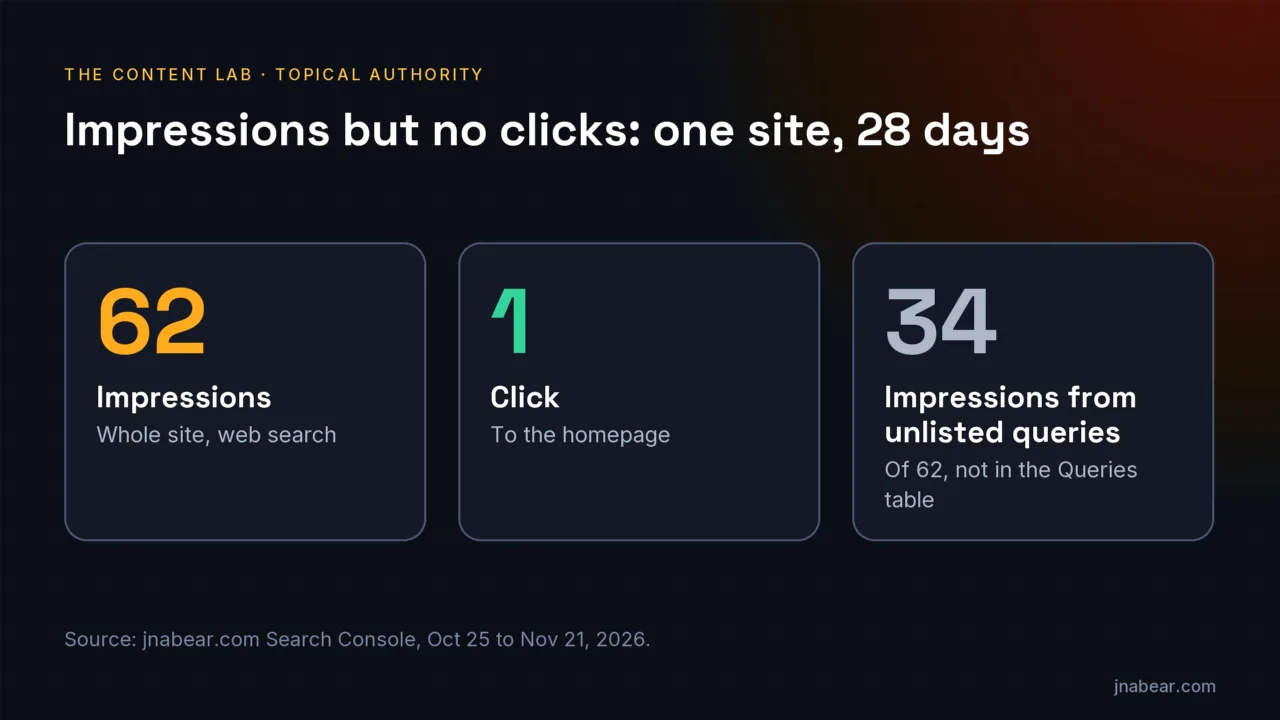
- This site had 62 impressions and 1 click from Oct 25 to Nov 21, 2026. No URL had more than 13 impressions, and 34 of the 62 came from queries Search Console does not list.
- Rewrite a title only when a page holds a top-five position with steady impressions and still trails your other top-five pages. Below that, work on the page or wait.
On this page (7)
Why am I getting impressions but no clicks?
You are getting impressions but no clicks because Search Console counts a result as shown long before anyone is likely to click it. The usual causes are a low position, too few impressions to judge, an answer Google already gave on the results page, or a title that does not match the search.
Each cause leaves a different mark in the report, so check them in order. The table below is the short version. The rest of this page explains each row with Google's own counting rules, the math behind small numbers, and a real export from this site. If your page has no impressions at all, that is a different problem: see why a page is indexed but not ranking.
| Cause | What it looks like in Search Console | What to do |
|---|---|---|
| Position too low | Average position worse than 10, often 20 to 99 | Improve the page or aim it at a narrower query. A new title will not help yet. |
| Too few impressions to judge | Under about 100 impressions per page in the date range | Widen the date range, then wait for more data. |
| Answer shown on Google | Good position on short, factual queries where an AI Overview or featured snippet appears | Add what a summary cannot: steps, data, tools, prices, examples. |
| Wrong query match | Queries in the table that your page does not answer | Ignore them, or narrow the page to the queries it does answer. |
| Title or snippet mismatch | Top-five position, steady impressions, CTR far below your other top-five pages | Rewrite the title and meta description to match the query. |
| Counting differences | Totals that differ between the chart and the tables | Compare chart to chart and page to page, never across. |
What counts as an impression in Search Console?
An impression in Search Console is counted when a link to your site appears on the page of results a person loads. Google's help page says this counts "whether or not the item is scrolled into view." It defines an impression as a link a user "has seen (or potentially seen)".
That one rule explains most cases of impressions but no clicks. A result at position 9 on a phone can sit several screens down. It still earns an impression the moment the page loads. Google lists a few exceptions:
- Carousels: an item must be scrolled into view inside the carousel to count.
- People also ask: expanding a question is not counted, but once it opens, the links inside it earn impressions.
- AI Overviews: standard impression rules apply, and every link in the overview shares the overview's single position.
- AI Mode: standard rules apply, and a follow-up question counts as a new query.
- Leaving and coming back during one search does not add a second impression.
Position works differently from what most people assume. Google records "the topmost position" your link held for each search, then averages it across all searches. For most result types, a click counts only when it sends the person from Google to your page. A click that stays inside Google, such as expanding an image, is not counted.
Click-through rate (CTR) is clicks divided by impressions. Google adds that these heuristics are "subject to change," so check the help page before you build a report on them.
Is it normal to have impressions but no clicks?
Yes, it is normal to have impressions but no clicks when the numbers are small. Clicks are rare events, and a few dozen impressions can easily produce none, even on a page that is doing fine.
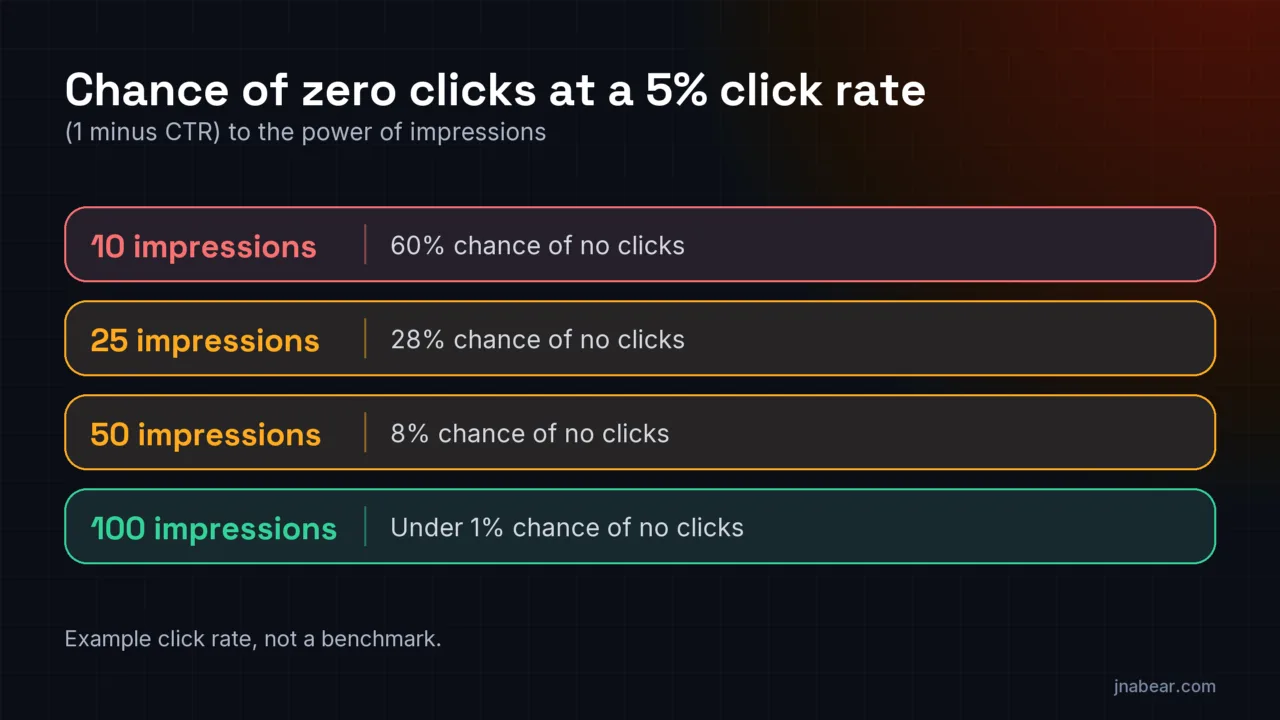
Here is the math. If each impression has the same chance of a click, the chance of zero clicks is (1 minus CTR) multiplied by itself once per impression. The table uses four example click rates. They are assumptions for the math, not benchmarks. Real impressions are not independent, so read this as a rough guide.
| Impressions | Zero clicks if CTR is 1% | If CTR is 2% | If CTR is 5% | If CTR is 10% |
|---|---|---|---|---|
| 10 | 90% | 82% | 60% | 35% |
| 25 | 78% | 60% | 28% | 7% |
| 50 | 61% | 36% | 8% | 0.5% |
| 100 | 37% | 13% | 0.6% | Under 0.1% |
| 200 | 13% | 2% | Under 0.1% | Under 0.1% |
Read it this way. At a 5% click rate, you would expect one click per 20 impressions on average. A page with 10 impressions and no clicks tells you almost nothing. A page with 100 impressions and no clicks at a good position tells you something is wrong. That is why the first fix for impressions but no clicks is often patience, or a longer date range.
What does impressions but no clicks look like on a real site?
On this site, impressions but no clicks is the normal state of almost every page. These numbers come from my own Search Console Performance report for jnabear.com: web search, Oct 25 to Nov 21, 2026. It is one small, young site, so read it as an example, not a benchmark.
| Measure (Oct 25 to Nov 21, 2026) | jnabear.com |
|---|---|
| Impressions, whole site (chart) | 62 |
| Clicks, whole site | 1, to the homepage |
| URLs with at least one impression | 36 |
| Most impressions on any one URL | 13 |
| URLs averaging position 10 or better | 25, with 70 impressions and 1 click between them |
| Impressions in the Queries table | 28 of 62. The other 34 came from queries the report does not list. |
| Average position, Oct 25 to Nov 7 | 13.0, over 27 impressions |
| Average position, Nov 8 to Nov 21 | 39.3, over 35 impressions |
| Desktop | 58 impressions, average position 29.6 |
| Mobile | 4 impressions, average position 2.5 |
Three patterns stand out. First, 25 URLs averaged a first-page position and got one click between them. With no more than 13 impressions on any URL, the table above says that is expected. It is not yet a title problem.
Second, the average position got worse while the site grew. In the first two weeks it was 13.0. In the last two it was 39.3. I worked out both figures from the daily chart, weighting each day by its impressions. The deep days start on Nov 12. Over the whole period, the largest query in the table, "semantic triples", averaged position 64.9 on 8 impressions. Impressions that deep pull the average down without any page losing ground. A worse average can mean you are showing up for more searches, not fewer.
Third, some impressions are too deep to matter. Two queries averaged positions 95 and 99, around the tenth page of results. Few people page that far, and the report does not say who did. I treat those rows as noise, not demand.
Do AI Overviews cause impressions without clicks?
AI Overviews can cause impressions without clicks, because a link cited in an overview earns an impression at the overview's position, and the summary may answer the question before anyone clicks. The same is true of featured snippets and other answers on the page.
The best public measure comes from the Pew Research Center. It tracked 900 U.S. adults' real Google searches in March 2025. When an AI summary appeared, people clicked a regular result in 8% of visits, against 15% when none appeared. They clicked a link inside the summary in 1% of visits. Searches with a summary also ended the browsing session more often: 26% against 16%.
This is the cleanest version of zero-click search. Your page can be the source and still get no visit. This site's glossary entry for negative parallelism averaged position 4.4 on 10 impressions with no clicks. Its queries ask for a definition, the kind a summary can answer. I cannot see whether a summary appeared for those searches, and at 10 impressions, zero clicks is expected anyway. To see AI-only data, Google has a separate report; the search console generative ai report guide explains how to read it. Note that Google lists a logging error that lowered impressions in that report for Nov 9 to Nov 11, 2026.
What you can control is the reason to click: a tool, a template, current prices, a worked example or data they cannot get from a two-line summary.
Why don't Search Console clicks and impressions add up?
Search Console clicks and impressions do not add up because the chart and the tables count in different ways. The chart counts by property: several of your pages in one search count as one impression. The Pages table counts each URL separately.
That is why this site's Pages table adds up to 109 impressions while the chart says 62. Google's own example has three pages from one site in one search: one impression by property, but one for each page by URL. Two more gaps are documented:
- Anonymized queries: Google omits queries "searched a very small number of times" to protect privacy. They count in the chart totals but not in the Queries table.
- Row limits: the table shows at most 1,000 rows. Google points to bulk data export for the fullest list.
- Canonical URLs: a click on a duplicate URL counts toward the canonical URL, not the one the person visited.
- Fresh data: the newest day can be preliminary and change within hours.
Watch for logged errors too. Google's data anomalies page says a logging error "prevented Search Console from accurately reporting impressions from May 13, 2025 until April 27, 2026." Clicks were not affected. If a year-over-year comparison crosses that window, the impression and CTR trends in it are not reliable.
How do you turn impressions into clicks?
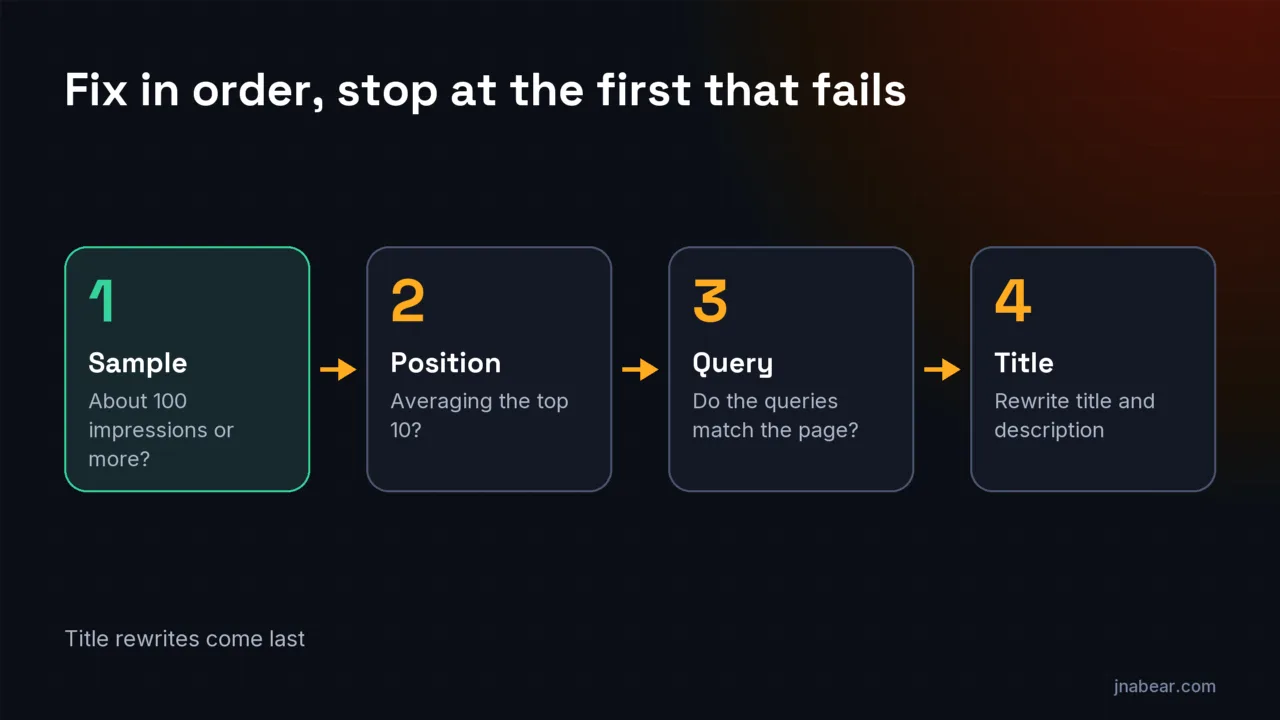
You turn impressions into clicks by fixing the cause the report points to, in order: wait for enough data, raise the position, then match the title to the query. Rewriting titles first is the most common mistake, because most pages with impressions but no clicks are not yet in a position to be clicked.
- Set the Performance report to the last 3 months, open the Pages tab and sort by impressions.
- Skip any page with fewer than about 100 impressions. Check it again next month.
- For pages averaging worse than position 10, work on the page itself: answer the query more completely, add first-hand detail, and add internal links from related pages.
- Click a page, then open the Queries tab. If the top queries are not what the page answers, narrow the page or accept that traffic will not come from them.
- For pages in the top five with steady impressions and a CTR far below your other top-five pages, rewrite the title and meta description. Put the query's words near the start and say what the page gives that the summary does not.
- After a change, compare the same date range length before and after, and allow a few weeks.
Google may not show your new title. Its title link guide lists the sources it can draw on, including the title element, the main heading, og:title and the text of links pointing to the page. Its snippet guide says Google "primarily uses the content on the page," and uses the meta description "when it describes the page better." Keep your title links consistent with the page's main heading so Google has one clear choice.
If a site has dozens of pages with impressions but no clicks and you cannot tell which to fix, a content audit sorts them into keep, improve, merge or remove, with the Search Console data behind each call. The free AI Search Visibility Audit starts with the same report and costs nothing.
Disclosure: I sell those services. A new site with fewer than a few hundred impressions a month needs no paid help with this. It needs more pages worth ranking, and time.
Sources
- Search Console Help: What are impressions, position, and clicks? (opens in a new tab) (verified Nov 2026)
- Search Console Help: Performance report (Search results), About the data (opens in a new tab) (verified Nov 2026)
- Search Console Help: Discrepancies between chart and table totals (opens in a new tab) (verified Nov 2026)
- Search Console Help: Dimensions and data groupings (opens in a new tab) (verified Nov 2026)
- Search Console Help: Data anomalies in Search Console (opens in a new tab) (verified Nov 2026)
- Google Search Central: Influencing your title links in search results (opens in a new tab) (verified Nov 2026)
- Google Search Central: Control your snippets in search results (opens in a new tab) (verified Nov 2026)
- Pew Research Center: Google users are less likely to click on links when an AI summary appears in the results (July 22, 2025) (opens in a new tab) (verified Nov 2026)
Topics & entities in this article
Frequently asked questions
Usually because your result sits too low to be reached, the numbers are too small to judge, Google answered the question on its own page, or your title does not match the search. Search Console counts an impression whenever your link is on the loaded page of results, scrolled into view or not.
Not on its own. Impressions mean Google is testing your page for a query. With few impressions, zero clicks is expected. It becomes a problem when a page holds a top-five position, earns 100 or more impressions, and still gets far fewer clicks than your other top-five pages.
It depends on your click rate. At 5%, you would expect one click per 20 impressions on average, but a page with 10 impressions still has a 60% chance of getting none. At 1%, expect one click per 100 impressions, and a 37% chance of none even at 100.
Yes, in most cases. Google counts an impression when your link is on the page of results a person loads, whether or not it is scrolled into view. Carousels are the main exception: an item must be scrolled into view inside the carousel to count.
Search Console's help pages set no target CTR, and click rates vary by position, query and device. Compare a page with your own pages at similar positions instead. A top-five page with a CTR far below its peers is the one worth a new title.
Yes. Standard impression rules apply to AI Overviews, and every link in an overview shares its single position. Pew Research Center found people clicked a regular result in 8% of visits when an AI summary appeared, against 15% without one, in March 2025.
The chart counts by property, so several of your pages in one search count as one impression. The Pages table counts each URL. The Queries table also leaves out rare, anonymized queries and shows at most 1,000 rows, so table totals can differ from the chart.
Related service
Content Audits
A content audit inventories every page on your site and grades what to keep, improve, merge, or remove, for established sites whose content has plateaued or declined.
Disclosure: this is a service I sell.