How to Write a Service Page: A Teardown of a Real One
Quick answer
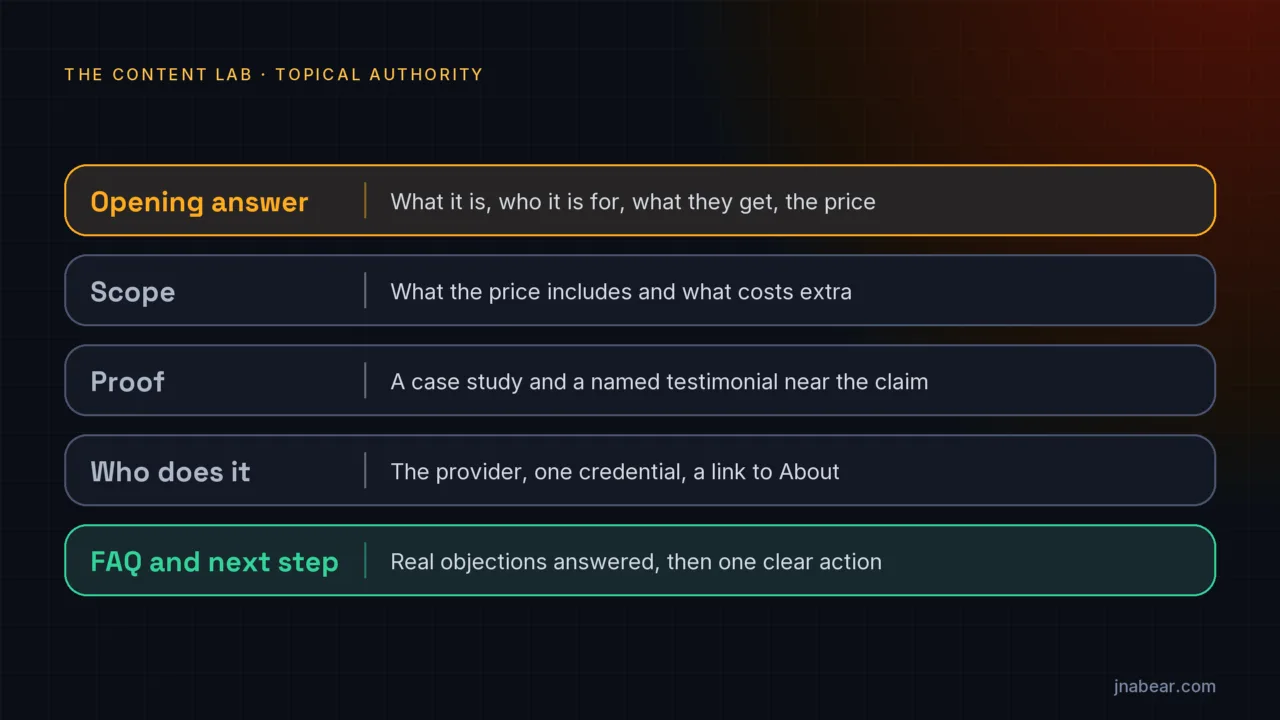
To write a service page, say in the first paragraph what the service is, who it is for, what the buyer gets and what it costs. Then show proof near your claims, state what the price includes, answer buying objections in an FAQ and end with one clear next step. Give each service its own page and its own title.
Key takeaways
- A service page sells one service to the people who searched for it, so its first paragraph must say what, who, what you get and what it costs.
- Google's guidance covers the title, the main heading, the description and internal links. NN/g's usability research on B2B sites covers price, scope, proof and objections, and applies just as well to a small service business.
- I scored my own six service pages against 18 checks on Nov 2, 2026. They passed 6 to 9 of 18. The weakest went from 6 to 10 after honest edits.
- All six showed a price and had a clean title. None stated scope next to the price, showed a case study, or answered buying objections in its FAQ.
- The weakest page claimed "one team" for design and SEO, while its own FAQ said the build is done with a partner. Fixing that was the first edit.
- Some fixes need facts only the owner has, such as timelines and revision rounds. Do not invent them to pass a checklist.
On this page (7)
What is a service page?
A service page is the page on a business website that sells one service: what it is, who it is for, what it costs and how to buy it. It is usually the page a searcher lands on after typing the service into Google, so it has to work for a stranger who knows nothing about you. One service, one page, one main next step.
| Attribute | What a service page has |
|---|---|
| Job | Turn a searcher with a need into an inquiry for one service |
| Audience | People who already know what they want and are choosing who to hire |
| Core parts | Headline, opening answer, who it is for, what is included, price, proof, process, FAQ, next step |
| Search role | Ranks for the service name and its variations, and is the page other content links to |
| Related pages | Home page (all services), service area pages (one service in one place), blog posts (questions around the service), landing pages (one campaign) |
The parts are not decoration. Each one answers a question the buyer is already asking. The checks below tie every part to a published source, and the template at the end puts them in order.
What is the difference between a service page and a landing page?
A service page is a permanent page about one service, built to be found in search and linked from the rest of the site. A landing page, in most setups, is built for one campaign, such as an ad or an email, and is often kept out of navigation and search. The service page answers every buying question for anyone who arrives. The landing page answers the questions one traffic source raises, and usually asks for one conversion.
The overlap is large, and some businesses use one page for both. If you run ads to a service, sending them to the service page is fine, as long as the page already does the job below.
What does a service page need? 18 checks with sources
A service page needs to be findable, clear in its first paragraph, specific about price and scope, and backed by proof. I turned that into 18 checks, each tied to Google's documentation or to usability research from Nielsen Norman Group (NN/g). I read every source on Nov 2, 2026.
| Check | Source |
|---|---|
| 1. The title names the service and the business, and is unique to the page | Google: "Write descriptive and concise text for your <title> elements." |
| 2. One main heading names the service and who it is for | Google: "Make it clear which text is the main title for the page." |
| 3. The opening paragraph says what, who, what you get and the price | NN/g, inverted pyramid: "Start content with the most important piece of information" |
| 4. Headings start with words that carry meaning | NN/g: "if users see only the first 2 words, they should still get the gist of the following section." |
| 5. Short paragraphs, lists and headings, no wall of text | Google SEO Starter Guide: "Break up long content into paragraphs and sections" |
| 6. A price is visible: fixed, starting, a range or scenarios | NN/g: "Show the price; and if the price is variable, offer common pricing scenarios." |
| 7. Scope sits next to the price: included, extra, customizable | NN/g: "Clearly indicate what kind of customization is available when you list your prices." |
| 8. Says who it is for, and ideally who it is not for | NN/g, B2B vs B2C: show "how its solutions fit the problems in that industry and scale." |
| 9. Claims are specific, with no boastful marketing language | NN/g: "credibility suffers when users clearly see that the site exaggerates." |
| 10. A case study near the claim: challenge, work, result | NN/g cites a B2B site whose case studies are structured "into Challenge, Solution, and Results" |
| 11. Testimonials name a real person, role and business | NN/g: "people care about who wrote testimonial: the author's job title and affiliation." |
| 12. The page says who provides the service and links to About | Google's helpful-content questions ask for "background about the author or the site that publishes it" |
| 13. Contact and after-purchase terms are easy to reach | Google's Search Quality Rater Guidelines (General Guidelines, Sept 11, 2025): contact and customer service information are "extremely important for websites that handle money" |
| 14. One primary next step, repeated, plus another way to reach you | My recommendation for the next step; for contact, NN/g: "Offer multiple ways to contact the organization." |
| 15. The FAQ answers buying objections: price, scope, timeline, support | NN/g: list "frequently asked questions about pricing, features, or ongoing post-purchase support." |
| 16. Links to supporting articles with descriptive anchor text | Google: link to resources that "could help your readers understand a given page on your site" |
| 17. The meta description pitches service, audience and price | Google's snippet guide: a good meta description "can bring all this data together." |
| 18. Structured data describes only what visitors can see | Google: "Don't mark up content that is not visible to readers of the page." |
Checks 1, 2, 16 and 17 are classic SEO: they decide whether the page is found and clicked. A clear opening (check 3) is also, in my experience, the text most likely to be lifted into an AI answer, which is why it works like an answer capsule. The rest decide whether the visitor who arrives gets in touch.
How do you write a service page, step by step?
Write the opening paragraph first, then build the page around the questions a buyer asks in order. This sequence follows the checks above.
- Write one sentence that says what the service is, who it is for, what they get and the starting price. Make it the first paragraph under the headline.
- Write the headline (H1) from that sentence: the service plus who it is for. Write a unique title tag and meta description from the same facts.
- List what is included and what costs extra, next to the price. If the price varies, give two or three typical scenarios.
- Add proof within one scroll of your main promise: one case study with the challenge, what you did and a result, and a testimonial with a full name and role.
- Say who does the work, with one credential line and a link to your About page.
- Write the process as three to five named steps, and the FAQ from the objections you actually hear: price, payment, timeline, revisions, ownership, support.
- End with one primary next step, and offer a second way to reach you, such as email.
- Link the page from your related articles, and link out to the articles that explain the service in depth, using the service name as anchor text.
Write for the buyer's search intent, not your org chart. Someone searching for the service wants to know if you fit, what it costs and what happens next, in that order.
How did my own service pages score?
My own six service pages passed 6 to 9 of the 18 checks when audited on Nov 2, 2026. Each page was read as rendered and scored against the rubric by an AI model, one run per page, one point per check, with the page text quoted as evidence. I publish the result because the gaps are instructive, and a teardown of someone else's page would be easier to write and less honest.
| Service page | Checks passed (of 18) |
|---|---|
| Conversion-Focused Copy | 9 |
| Local SEO Clusters | 9 |
| Content Audits | 8 |
| AI Content Humanization | 8 |
| Topical Authority Mapping | 8 |
| Web Design & SEO | 6, the subject of the teardown below |
The pattern across all six is more useful than the scores. Every page passed the title, scannability, visible price and internal links checks. Not one page passed these:
- An opening paragraph that states what, who, what you get and the price together
- Headings whose first two words say what the section covers
- Scope next to the price: what is included and what costs extra
- A case study with a challenge, the work and a result
- A visible line saying who provides the service, with a link to About
- After-purchase terms such as revisions, support or refunds
- An FAQ that answers price, timeline and support objections
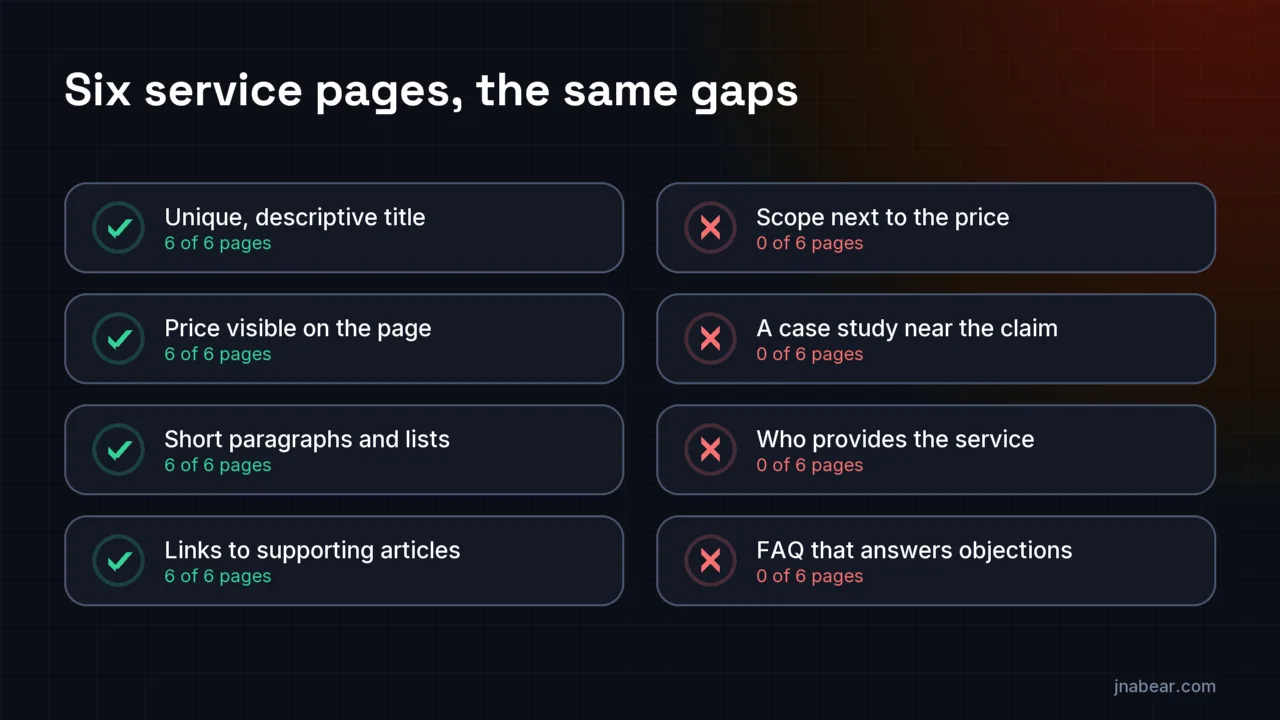
In other words, my pages were good at being found and weak at answering the buyer's next three questions. In my experience that split is common: the SEO basics are easy to template, while scope, proof and objections need facts from the business.
Teardown: the Web Design & SEO page, before and after
The Web Design & SEO page scored lowest, 6 of 18, and its biggest problem was a contradiction. The summary, the tagline and the meta description all said "one team" owns design, development and search. The page's own FAQ said: "Design and development are delivered with Stoute Web Solutions; I own the SEO and content strategy end to end." A buyer who reads to the FAQ finds the headline was not quite true.
| Part | Before | After |
|---|---|---|
| H1 | Web Design With SEO Built In | Custom WordPress Websites With SEO Built In, for New and Rebuilt Sites |
| Tagline | Design, development, and SEO from one team. | SEO planned by JNAbear. Design and build with Stoute Web Solutions. |
| Opening paragraph | Said what and repeated "one team", with no audience or price | Says what, who it is for, the starting price of $3,500, and who does which part |
| Problem statement | "When the designer, developer, and SEO are three different vendors, search always loses." | Drops the absolute and says what the process does instead: the SEO plan comes before design |
| Meta description | Repeated "One team for design, development, and SEO" | Names the partnership and the starting price |
| FAQ | Two questions, neither about price, and an unnamed "I" | Adds "How much does a website cost?" and a credential line |
| Process heading | How it works | How Web Design & SEO works (changed on every service page) |
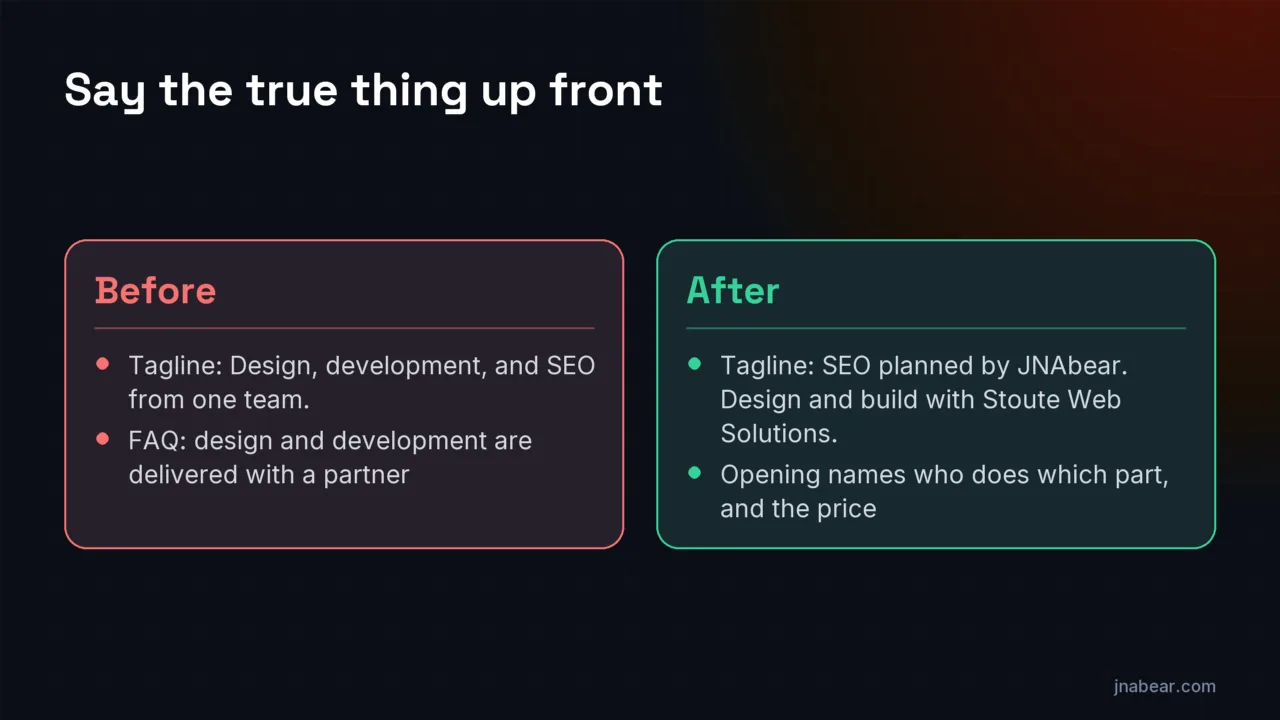
The fix for a contradiction is to say the true thing plainly. A named partner is a strength when you say it up front, and a trust problem when the buyer finds it in the FAQ. The same edit names Joseph Nicholas Abear and Stoute Web Solutions and what each one does, and the FAQ now carries a credential line.
After the edit, a second audit with the same rubric scored the page 10 of 18, up from 6: the opening paragraph, the claims, the provider and the meta description checks now pass. Most of the rest is still open because it needs facts I will not make up to pass a checklist:
- What $3,500 includes: page count, revision rounds, and what costs extra
- A typical timeline from kickoff to launch
- Who owns the site and the hosting after launch, and what support follows
- A case study of a site build, with the challenge, the work and a measured result
- A testimonial from a web design client
- An About link in the body copy beside the provider names, which needs a change to the shared service template
Three more checks still fail and are next on my list: the H1 names a kind of project rather than a buyer, the who-it-is-for line has no business type, and most headings still open with words like "How" or "Go deeper."
That list is the honest lesson of the teardown. A checklist can tell you a section is missing, but only the business can fill it. Writing "fast turnaround" with no number would pass a lazy audit and fail a careful buyer.
Service page template: what to put in each section
Copy this order and fill each row with your own facts. If you cannot fill a row truthfully yet, leave the section out until you can.
| Section | Its job | Fill in |
|---|---|---|
| Title tag and meta description | Win the click from search | {Service} for {who}, {Business}. Description: what, who, starting price. |
| H1 | Confirm the searcher is in the right place | {Service} for {who} |
| Opening paragraph | Answer what, who, what you get and cost | {Business} provides {service} for {who}: {what they get}, from {price}. |
| Who it is for, and not for | Let the right buyer self-select | Best for {situation}. Not a fit if {situation}. |
| What is included | Set scope next to the price | Included: {list}. Costs extra: {list}. |
| Proof | Back the main promise | {Client} needed {challenge}. We {work}. Result: {number} in {time}. |
| Who does the work | Name the provider | {Name}, {credential}. About page link. |
| Process | Make the next weeks predictable | 3 to 5 named steps, with timing |
| FAQ | Answer objections | Price and payment, timeline, revisions, ownership, support |
| Next step | One clear action | One button, plus email as a second route |
Run the opening paragraph through the free AEO Checker before you publish. It flags openings that start with a back-reference, run too long or put a link in the first sentence, which are problems that make a paragraph harder to quote on its own.
If you would rather hand this off, two of my services cover it. Conversion-Focused Copy rewrites a service page around these sections, from $550 a page. A content audit grades every page on your site and ranks the fixes, from $750. The free AI Search Visibility Audit is the place to start if you are not sure which one you need.
Disclosure: I sell those services, and this article scored my own pages, weak ones included, so you can judge whether I follow my own checklist.
Sources
- Google Search Central: Influencing your title links in search results (opens in a new tab) (verified Nov 2026)
- Google Search Central: SEO Starter Guide (opens in a new tab) (verified Nov 2026)
- Google Search Central: Creating helpful, reliable, people-first content (opens in a new tab) (verified Nov 2026)
- Google Search Central: Control your snippets in search results (opens in a new tab) (verified Nov 2026)
- Google Search Central: Link best practices (opens in a new tab) (verified Nov 2026)
- Google Search Central: General structured data guidelines (opens in a new tab) (verified Nov 2026)
- Google Search Central: Spam policies for Google web search (updated Aug 28, 2026) (opens in a new tab) (verified Nov 2026)
- Google: Search Quality Rater Guidelines (General Guidelines, Sept 11, 2025) (opens in a new tab) (verified Nov 2026)
- Nielsen Norman Group: Inverted Pyramid: Writing for Comprehension (opens in a new tab) (verified Nov 2026)
- Nielsen Norman Group: F-Shaped Pattern of Reading on the Web (opens in a new tab) (verified Nov 2026)
- Nielsen Norman Group: What B2B Designers Can Learn from B2C About Building Trust (opens in a new tab) (verified Nov 2026)
- Nielsen Norman Group: B2B vs. B2C Websites (opens in a new tab) (verified Nov 2026)
- Nielsen Norman Group: How Users Read on the Web (opens in a new tab) (verified Nov 2026)
Topics & entities in this article
Frequently asked questions
A headline naming the service and who it is for, an opening paragraph with what, who, what you get and the price, what is included, proof such as a case study and a named testimonial, the process, an FAQ that answers objections, and one clear next step.
Yes, where you can. Nielsen Norman Group's advice is "Show the price; and if the price is variable, offer common pricing scenarios." A starting price or a range is better than "contact us for a quote" alone.
Long enough to answer the buyer's questions and no longer. Put the essentials in the first paragraph, because many visitors scan, then cover scope, proof, process and objections under clear headings.
Yes. One page per service lets each page target one search, answer one buyer's questions and carry its own title and description, which Google asks to be unique to each page.
No. A service page sells one service to anyone who needs it. A service area page targets one service in one place, so it needs content specific to that place. Google's spam policies list pages "targeted at specific regions or cities that funnel users to one page" as doorway abuse.
AI can draft one, but the facts that make a service page convert, such as price, scope, timeline and proof, have to come from the business. Check every claim, and remove any you cannot back.
Related service
Conversion-Focused Copy
Conversion-focused copy turns organic traffic into leads. Every page gets a sharp value proposition, objection handling, and one clear call to action, aligned with the search intent that earned the click.
Disclosure: this is a service I sell.