Quick answer
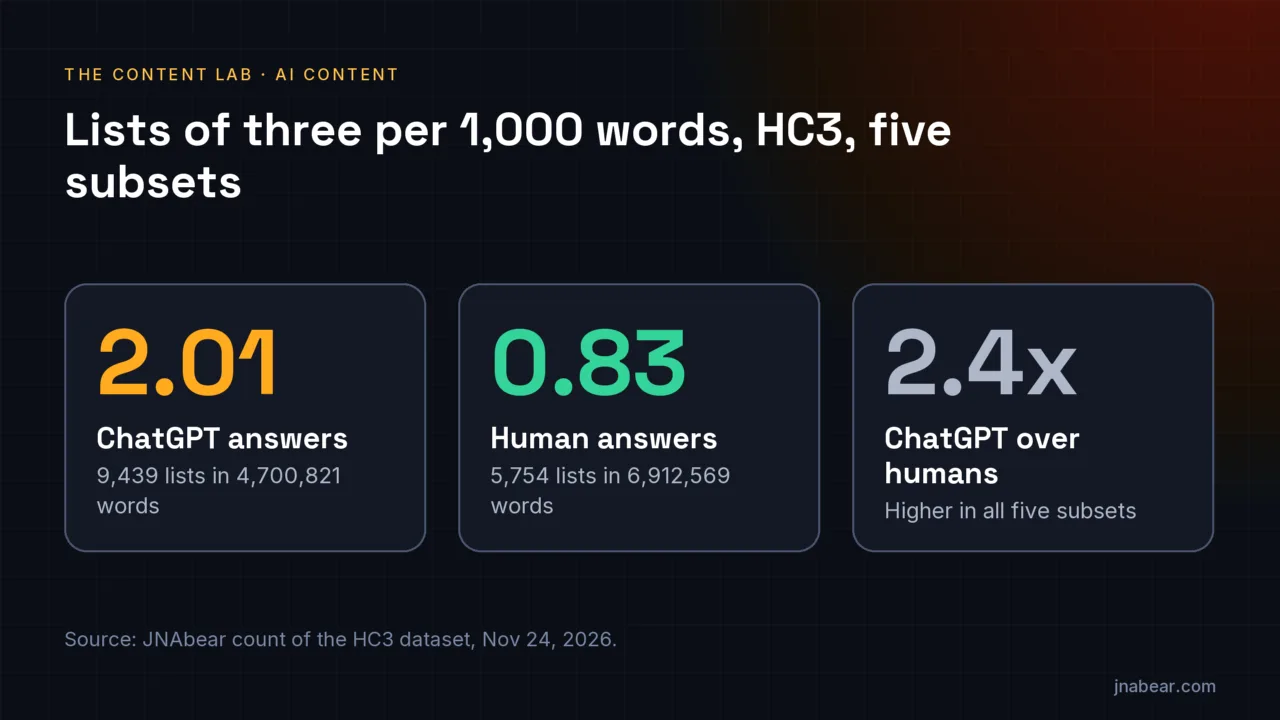
Why does AI use the rule of three? No study has proven why. The best documented clue is OpenAI's own note at ChatGPT's launch that its trainers "prefer longer answers that look more comprehensive", and a list of three looks complete. In the HC3 dataset, early ChatGPT wrote 2.01 lists of three per 1,000 words. Human answers wrote 0.83, so ChatGPT did it about 2.4 times as often.
Key takeaways
- In the HC3 dataset, ChatGPT answers wrote 2.01 lists of three per 1,000 words. Human answers wrote 0.83. ChatGPT's rate was higher in all five subsets, by 1.66 to 3.74 times.
- The gap holds when answers of similar length are compared. In answers of 100 to 199 words, ChatGPT wrote 2.08 per 1,000 words and people 0.82.
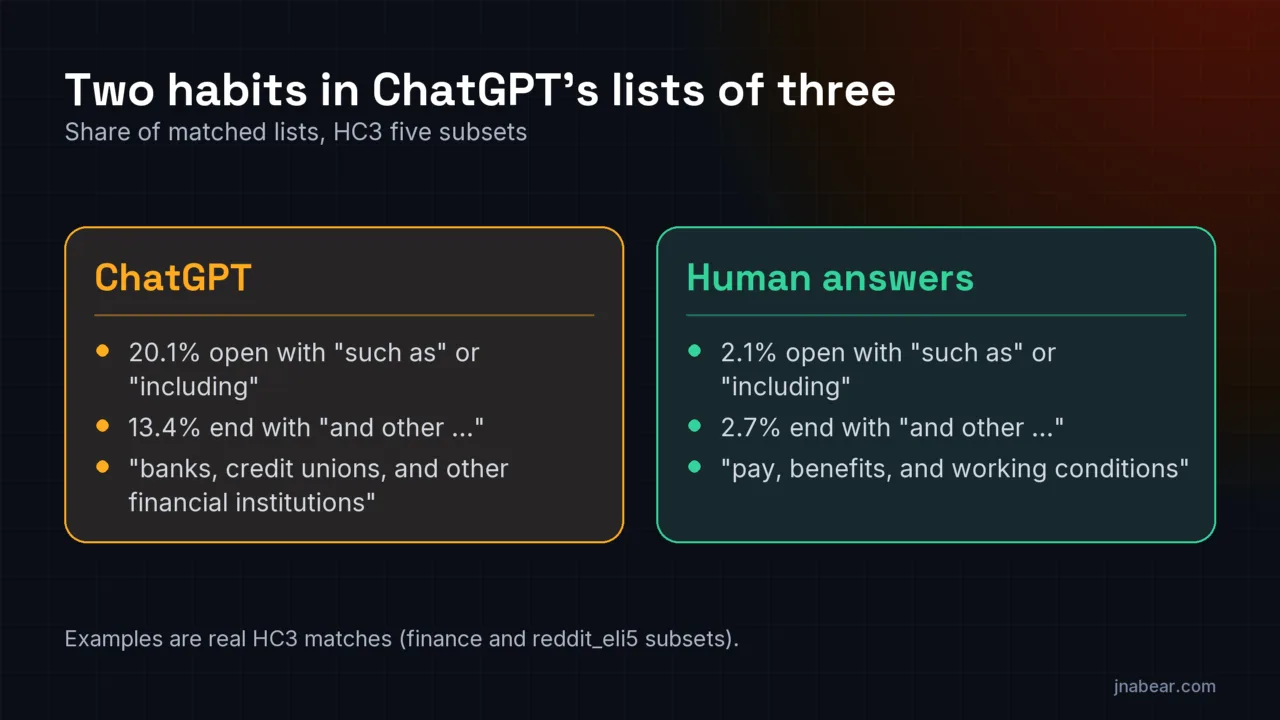
- ChatGPT's lists had two habits. 20.1% opened with "such as" or "including", against 2.1% of human lists. 13.4% ended with "and other ...", against 2.7%.
- No one has proven why models do this. OpenAI wrote at ChatGPT's launch that its trainers preferred longer answers that look more comprehensive. That fits the pattern without proving it.
- A list of three is a weak sign of AI on its own. The checker's flag, two or more lists in one text, caught 7.1% of ChatGPT answers of 100+ words and 2.8% of human ones.
- HC3 cannot measure current models. Its ChatGPT answers date from Dec 2022 to Jan 2023. An AI reviewer read 50 matches per side: 46 of ChatGPT's and 36 of the human ones were real lists of three.
On this page (6)
Why does AI use the rule of three?
No study has proven why AI uses the rule of three. The clearest clue comes from OpenAI itself. When it launched ChatGPT, it wrote that the model is often too wordy, partly because its trainers "prefer longer answers that look more comprehensive".
That launch post, from Nov 30, 2022, also says ChatGPT was trained with reinforcement learning from human feedback (RLHF), using the same methods as InstructGPT. In that method, people rank a model's answers, and the model is tuned toward the answers they rank higher. A list of three can make an answer look complete with little effort. So a rater's taste for complete-looking answers could reward it. That is a plausible link. No source I found tests it for lists of three.
Other research points the same way in general terms. A 2023 paper by Prasann Singhal and colleagues found that RLHF pushes models toward longer outputs, partly through length bias in the preference data. A 2025 PNAS study by Alex Reinhart and colleagues found that instruction-tuned models write less like people than base models do. That study did not count lists of three. It found that GPT-4o used phrasal coordination, joining words and phrases with "and" or "or", about 1.9 times as often as human text.
The training-data story is weaker. Some blogs say models learned the habit from journalism and essays, where lists of three are common. That may be true, but I found no study that measures it. Treat it as a guess.
What is the rule of three in writing?
The rule of three in writing is the habit of grouping ideas in threes, because a trio tends to feel complete and memorable. Wikipedia's article on the rule says it grew out of oral storytelling.
Rhetoric has narrower names for parts of it. A tricolon is three parallel parts of similar length and form. Silva Rhetoricae, Brigham Young University's rhetoric reference, defines it as three parallel elements of the same length in a series. A hendiatris is different: three words that express a single idea. Isocolon is the wider figure, parallel parts of about the same length. English Wikipedia now treats tricolon inside its isocolon article.
Classic examples are old and famous. Suetonius records that Caesar's Pontic triumph displayed an inscription of three words, "I came, I saw, I conquered", in Latin VENI, VIDI, VICI. Lincoln's Gettysburg Address, given Nov 19, 1863, ends with government "of the people, by the people, for the people". The Declaration of Independence names "Life, Liberty and the pursuit of Happiness", with no comma before "and".
Most AI lists of three are plainer than these. They are simple lists, such as three causes, three benefits or three adjectives. This post counts that plain shape, and the rule section below explains exactly what counts.
Does ChatGPT use the rule of three more than people do?
Yes, in the HC3 dataset early ChatGPT used the rule of three much more than people did. It wrote 2.01 lists of three per 1,000 words, against 0.83 for human answers to the same questions.
HC3, the Human ChatGPT Comparison Corpus, was built by Biyang Guo and colleagues and posted to arXiv on Jan 18, 2023. It pairs questions with human answers, mostly from existing datasets, and with answers from ChatGPT's preview website. The team asked each question in a fresh thread. For the reddit_eli5 subset, they added "Explain like I'm five" to each question. The paper itself remarks that ChatGPT writes in an organized way, with connectives like "Firstly ... Secondly ... Finally". It does not count lists of three.
I ran this site's rule-of-three rule over the five English subsets: 58,546 human answer records and 26,885 ChatGPT records, 85,431 in all. Rates are per 1,000 words, so ChatGPT's longer answers do not inflate its side.
| HC3 subset | Human lists | Human words | Human per 1,000 | ChatGPT lists | ChatGPT words | ChatGPT per 1,000 | ChatGPT over human |
|---|---|---|---|---|---|---|---|
| reddit_eli5 | 4,805 | 5,905,891 | 0.81 | 4,916 | 2,929,498 | 1.68 | 2.06x |
| finance | 372 | 697,928 | 0.53 | 1,604 | 935,712 | 1.71 | 3.22x |
| medicine | 68 | 106,527 | 0.64 | 596 | 249,341 | 2.39 | 3.74x |
| open_qa | 83 | 35,982 | 2.31 | 1,657 | 429,955 | 3.85 | 1.67x |
| wiki_csai | 426 | 166,241 | 2.56 | 666 | 156,315 | 4.26 | 1.66x |
| All five | 5,754 | 6,912,569 | 0.83 | 9,439 | 4,700,821 | 2.01 | 2.41x |
ChatGPT is higher in every row. An exact rate test gives p below 0.001 in each subset. The 2.4 in the last row is pooled, and the two sides have different subset mixes: open_qa, where both rates run high, holds 9.1% of ChatGPT's words and 0.5% of the human words. Weighted to one subset mix, the gap is about 2.1 to 2.2 times. That test treats each list as independent, which overstates certainty a little, since lists within one answer can cluster. The gaps are large enough that this does not change the direction.
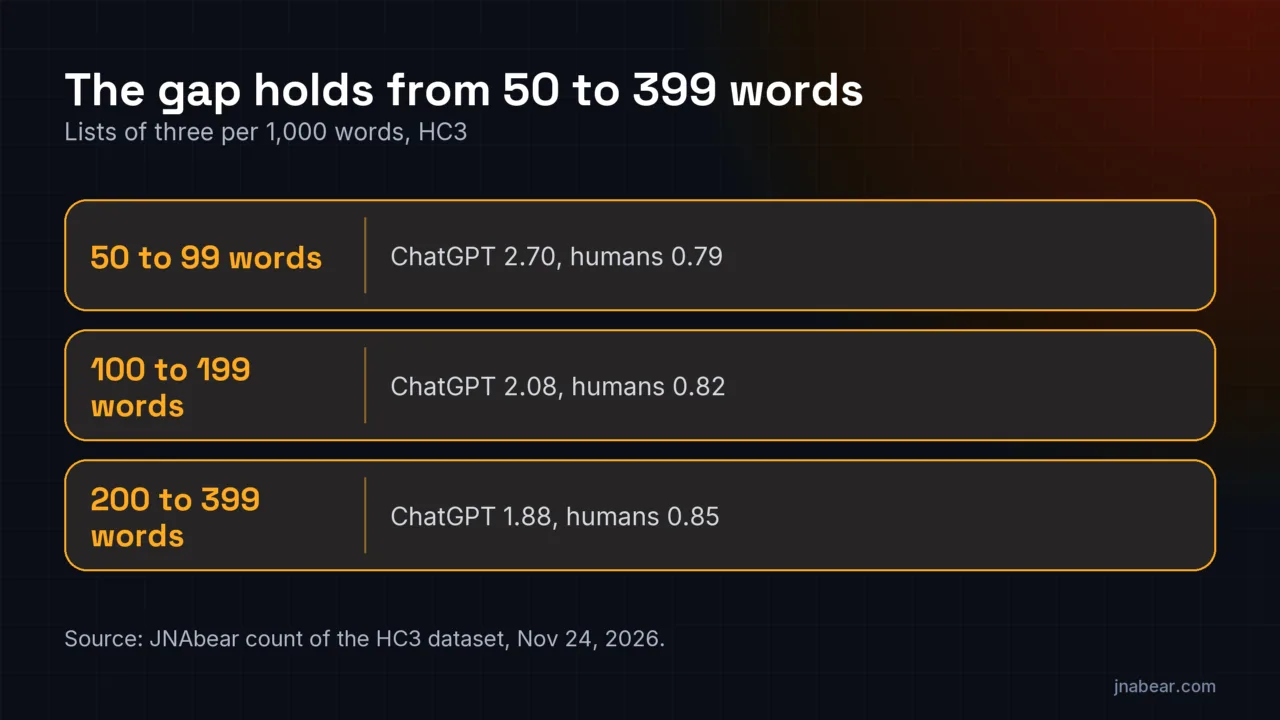
Answer length does not explain the gap. ChatGPT's answers average 175 words and the human ones 118. Grouped by length, the rates stay far apart.
| Answer length | Human answers | Human per 1,000 | Human with at least one | ChatGPT answers | ChatGPT per 1,000 | ChatGPT with at least one |
|---|---|---|---|---|---|---|
| 50 to 99 words | 15,868 | 0.79 | 5.4% | 2,539 | 2.70 | 19.1% |
| 100 to 199 words | 12,794 | 0.82 | 10.2% | 14,825 | 2.08 | 24.5% |
| 200 to 399 words | 6,871 | 0.85 | 19.1% | 8,975 | 1.88 | 31.5% |
Very short answers are the exception. Under 50 words, the two sides are close, at 0.89 and 0.84 per 1,000 words, and ChatGPT wrote only 12 lists there. Answers of 50 to 399 words hold 98% of ChatGPT's answers. Across all answers, 25.9% of ChatGPT's held at least one list of three, against 8.3% of human answers. Some records repeat. With exact repeats removed, the rates are 2.02 for ChatGPT and 0.83 for people, so repeats change nothing.
HC3 rule-of-three counts, Nov 24, 2026 (CSV)
Aggregate counts only, no answer text: one row per subset and side, as released and with spacing repaired, plus the length bands, the two list habits, the checker flag rates and the precision samples. Free to reuse with a link to this page.
Why the spacing repair matters
Much of HC3's human text is stored with spaces before punctuation, as "pay , benefits , and working conditions", and the rule cannot see a list written that way. As released, the human reddit_eli5 answers show 0 lists of three in about 6 million words.
So I ran the count a second time with that spacing repaired. The repair removes spaces before punctuation and rejoins split contractions such as "do n't". The rule itself stayed the same. The repair lifted the human total from 908 lists (0.13 per 1,000 words) to 5,754. ChatGPT's text was already clean, so its count stayed at 9,439. All figures in this post use the repaired run unless they say otherwise. The CSV holds both runs.
How the count was run
On Nov 24, 2026, I ran the rule-of-three check from this site's AI Content Tell Checker over every non-empty answer in five HC3 subsets. Then I read random samples of the matches to estimate precision.
The rule counts a list of exactly three items in "a, b, and c" form, or "a, b and c" when each item is one word. Items after the first may run to three words, so "fast service, fair prices, and clean job sites" counts. It skips most tails of longer lists, though 2 of the 100 sampled matches were the last three items of a four-item list. The rule shipped in the checker on Nov 20, 2026, four days before this run, and was built from review test cases rather than from HC3. The data is Hello-SimpleAI/HC3 on Hugging Face, revision 4d0ff18, subsets reddit_eli5, finance, medicine, open_qa and wiki_csai. A word is a run of letters and digits, with apostrophes and hyphens kept inside. Empty answers were skipped, which is why the ChatGPT total is 26,885 where the paper lists 26,903.
How accurate the matches are
Precision was 92% for ChatGPT matches and 72% for human matches, in random samples of 50 per side. False matches inflate the human count more, so precision alone would put the gap wider. Missed lists could pull the other way, as the next paragraph explains.
An AI reviewer (Claude) read each sampled match in context. No person has re-read these samples, so treat the figures as estimates. A match counted as real if it was a list of three parallel items. The false human matches mostly came from loose Reddit punctuation, such as "Basically, energy and matter". Two of the 4 false ChatGPT matches were similar, such as "For example, dogs and bears". Applying the sample rates gives about 1.85 lists per 1,000 words for ChatGPT and 0.60 for people, about 3.1 times. Samples of 50 are small, so read that as a rough figure.
| Sample (read by an AI reviewer) | Read | Real lists of three | Precision |
|---|---|---|---|
| ChatGPT matches (random) | 50 | 46 | 92% |
| Human matches, spacing repaired (random) | 50 | 36 | 72% |
- I measured precision only. I did not measure how many real lists the rule misses. Messy human punctuation probably hides more human lists than ChatGPT ones, which would narrow the gap.
- HC3 is one dataset of short answers to questions, collected from Dec 2022 to Jan 2023. It says nothing direct about long marketing copy or current models.
- The human side mixes Reddit answers, Wikipedia text and other sources, so it describes those texts, not people in general.
- HC3's dataset card applies CC BY-SA unless a source dataset has a stricter license. Examples here are short and credited, and the CSV holds counts alone.
What do AI lists of three look like?
AI lists of three in HC3 often follow a template: they open with "such as" and end with a vague "and other ...". People list three things too, and their lists rarely use that template.
| Kind of list | ChatGPT example | Human example |
|---|---|---|
| Concrete things | "sunlight, water, and carbon dioxide" (HC3, reddit_eli5) | "pay, benefits, and working conditions" (HC3, reddit_eli5) |
| Actions | "understand, interpret, and generate human language" (HC3, wiki_csai) | "Teach, learn, and maintain temples" (HC3, reddit_eli5) |
| Qualities or ideals | "stability, prosperity, and progress" (HC3, reddit_eli5) | "straightforward, uncomplicated, and unironic" (HC3, reddit_eli5) |
Two habits stand out in the full count. 1,896 of ChatGPT's 9,439 lists (20.1%) opened with "such as" or "including", against 123 of 5,754 human lists (2.1%). And 1,264 of ChatGPT's lists (13.4%) ended with "and other ...", as in "banks, credit unions, and other financial institutions" (HC3, finance). Only 153 human lists (2.7%) did that.
Those two habits often work together. "Such as" promises examples, and "and other" admits the list is incomplete. The result sounds thorough while adding little. In my judgment, that filler is the part readers notice, more than the number three.
Is the rule of three a sign of AI writing?
The rule of three is a weak sign of AI writing on its own, because people use it constantly. Wikipedia's AI-cleanup editors still list it, noting that "LLMs often use this structure to make superficial analyses appear more comprehensive."
That page, "Signs of AI writing", is an advice page from WikiProject AI Cleanup and is not a Wikipedia policy. Its "Rule of three" section says the signal is stronger where people rarely bother with style, such as edit summaries. It gives examples from real edits, with no frequency counts.
Not every famous AI tell holds up when counted. An earlier count on this site, of the "it's not X, it's Y" habit in the HC3 dataset, found human answers used that pattern more than early ChatGPT did. Lists of three went the other way, and clearly. Each tell needs its own count.
Two newer preprints measure triads directly, and neither is peer reviewed. One, by Asim Bakhshi and posted in March 2026, compared 225 argumentative texts. It reports 7.13 tricolons per document for four current models against 3.73 for human experts. Its annotation was done by a language model, with no reported reliability check. The other, SlopBench from September 2026, scored 18 models. For the median model it found no excess in email or essays, and at least three times the human rate in social posts, where the human baseline was 2009 tweets. Neither paper states a cause.
The checker on this site flags lists of three only at two or more in one text. In HC3, that flag caught 1,690 of 23,843 ChatGPT answers of 100 words or more (7.1%) and 618 of 22,167 human ones (2.8%). So most ChatGPT answers never trip it, and some human ones do. I also ran the rule over the prose of this site's five newest posts, 19,227 words drafted with AI and edited by hand. It found 21 lists, or 1.09 per 1,000 words, between the human and ChatGPT rates. Most were plain lists of real things, such as "header, navigation and footer". By the same rule, this post's prose holds 10 matches, and every one is a quoted example. The count finds passages worth a second look. It cannot name the author. Whether AI content hurts rankings is a separate question with its own answer.
How do you stop ChatGPT from using the rule of three?
To stop ChatGPT from using the rule of three, ask in the prompt for only the items each point needs. Then edit by hand, cutting padded third items and vague "and other" endings.
I have not tested how much a prompt reduces lists of three, so treat the prompt step as a starting point. The editing steps work whatever the prompt did.
- In the prompt, tell the model to list only the items that matter, whether that is one, two or five, and to avoid "such as A, B, and C" filler.
- Search the draft for ", and" and "and other". Those strings find most of the lists this rule counts.
- For each list, ask whether the third item adds anything. If it repeats the first two, cut it.
- Replace "and other ..." with the specific thing you mean, or end the list where your knowledge ends.
- Example edit, my own wording: "We offer fast, reliable, and affordable service" becomes "Most repairs are done the same day, and we quote before we start." The new sentence also has to be true.
- Keep lists of three that are real. A recipe with three ingredients needs all three.
The AI Content Tell Checker on this site runs this same rule and highlights each list it finds, along with other common AI tells. Disclosure: I sell AI Content Humanization, an editing service for AI drafts, so weigh that. If a draft only needs its padded lists trimmed, the steps above are enough.
Sources
- Guo et al.: How Close is ChatGPT to Human Experts? Comparison Corpus, Evaluation, and Detection (arXiv, Jan 18, 2023) (opens in a new tab) (verified Nov 2026)
- GitHub: chatgpt-comparison-detection README, project timeline (collection from Dec 11, 2022; release Jan 18, 2023) (opens in a new tab) (verified Nov 2026)
- Hugging Face: Hello-SimpleAI/HC3 dataset card (revision 4d0ff18) (opens in a new tab) (verified Nov 2026)
- OpenAI: Introducing ChatGPT (Nov 30, 2022) (opens in a new tab) (verified Nov 2026)
- Ouyang et al.: Training language models to follow instructions with human feedback (InstructGPT, arXiv, Mar 4, 2022) (opens in a new tab) (verified Nov 2026)
- Singhal et al.: A Long Way to Go: Investigating Length Correlations in RLHF (arXiv, Oct 5, 2023) (opens in a new tab) (verified Nov 2026)
- Reinhart et al.: Do LLMs write like humans? Variation in grammatical and rhetorical styles (PNAS, 2025) (opens in a new tab) (verified Nov 2026)
- Wikipedia: Signs of AI writing, "Rule of three" (opens in a new tab) (verified Nov 2026)
- Wikipedia: Rule of three (writing) (opens in a new tab) (verified Nov 2026)
- Silva Rhetoricae (BYU): Tricolon (opens in a new tab) (verified Nov 2026)
- Wikipedia: Hendiatris (opens in a new tab) (verified Nov 2026)
- Suetonius: Life of Julius Caesar, 37 (Loeb, 1913, LacusCurtius) (opens in a new tab) (verified Nov 2026)
- Suetonius: Divus Julius, 37, Latin text (LacusCurtius) (opens in a new tab) (verified Nov 2026)
- Abraham Lincoln Online: Gettysburg Address (Bliss copy) (opens in a new tab) (verified Nov 2026)
- National Archives: Declaration of Independence transcript (opens in a new tab) (verified Nov 2026)
- Bakhshi: Saying More Than They Know: A Framework for Quantifying Epistemic-Rhetorical Miscalibration in Large Language Models (arXiv preprint, Mar 27, 2026) (opens in a new tab) (verified Nov 2026)
- Roongta et al.: SlopBench: How Well Can We Rank Language Models by Slop? (arXiv preprint, Sep 27, 2026) (opens in a new tab) (verified Nov 2026)
Topics & entities in this article
Frequently asked questions
It is the habit of AI models grouping things in threes, such as three benefits or three adjectives. In the HC3 dataset, early ChatGPT wrote 2.01 lists of three per 1,000 words, against 0.83 for human answers to the same questions. That is about 2.4 times as often.
No one has proven why. OpenAI wrote at ChatGPT's launch that its trainers preferred longer answers that look more comprehensive, and a list of three looks complete. That fits the pattern, but no study has tested it for lists of three.
A tricolon is three parallel parts of similar length and form, as in "Veni, vidi, vici" or "of the people, by the people, for the people". A hendiatris differs: three words that express one idea. Isocolon is the wider figure of parallel parts.
No. People use lists of three constantly. In HC3, two or more lists in one answer of 100+ words appeared in 7.1% of ChatGPT answers and 2.8% of human ones. Treat lists of three as a reason to reread a passage, not as proof of authorship.
HC3 cannot say, because its ChatGPT answers date from Dec 2022 to Jan 2023. A March 2026 preprint, not peer reviewed, reported 7.13 tricolons per document for four current models against 3.73 for human experts, in 225 argumentative texts.
Ask for only the items each point needs. Then search the draft for ", and" and "and other". Cut third items that repeat the first two, and replace "and other ..." with the specific thing you mean. Keep the lists of three that are real.
Related service
AI Content Humanization
AI content humanization is a line-by-line editorial rewrite that turns AI drafts into accurate, on-brand copy, for agencies, publishers, and teams producing content at scale.
Disclosure: this is a service I sell.