Quick answer
Why does AI say it's not x it's y? No cause is proven. One proposed explanation, from a 2026 preprint, blames promotional training text plus preference tuning, and that paper did not test the cause directly. In HC3 answers collected from Dec 2022 to Jan 2023, ChatGPT used the three-shape family 0.075 times per 1,000 words and humans 0.126, or 0.193 with split contractions rejoined. For the "it's not X, it's Y" shape alone, the rates are 0.015, 0.017 and 0.082.
Key takeaways
- In the HC3 dataset, ChatGPT answers collected from Dec 2022 to Jan 2023 used the three shapes of this pattern 0.075 times per 1,000 words. Human answers used them 0.126 times. Per 1,000 words, ChatGPT was lower in the three subsets with enough matches to compare and numerically lower in two very small ones.
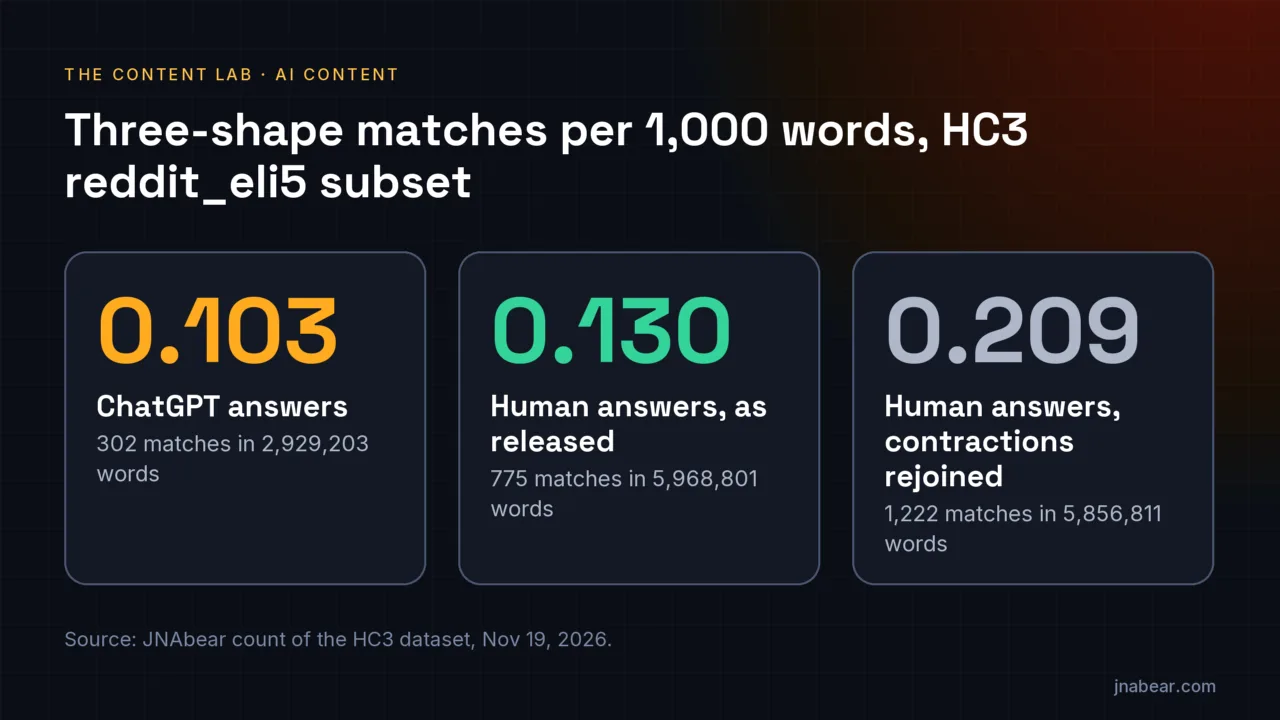
- Like for like, in the reddit_eli5 subset, the human rate is 1.26 times ChatGPT's as released and 2.02 times once split contractions are rejoined. The pooled gap is larger partly because the two sides have different subset mixes.
- The as-released gap comes almost entirely from "not just X, but Y". On the rule's "it's not X, it's Y" shape, ChatGPT scored 0.015 per 1,000 words, against 0.017 for humans as released and 0.082 rejoined.
- ChatGPT passed the human rate on one shape in reddit_eli5: "not X, but Y", at 0.053 against 0.037. That result leans on "but rather", which skips the rule's parallel-opening test. "But rather" opened 286 of 1,037 ChatGPT candidates and 88 of 2,749 human candidates.
- Wikipedia's "Signs of AI writing" page lists the pattern as a common chatbot habit and says human writers use it too (read Nov 19, 2026).
- A July 2026 preprint found three Claude models averaged about twice the human rate in oratory, driven by Sonnet and Opus while Haiku matched the human rate, and about a fifth of it in informal Q&A. It counted related forms, and its author calls both results suggestive.
- HC3 cannot measure current models. Hand checks found 36 of 40 human and 37 of 40 ChatGPT matches were real across all three shapes. On the third shape alone, 54 of 71 ChatGPT matches were real.
On this page (8)
Why does AI say it's not X, it's Y?
Why does AI say it's not x it's y? No cause is proven. One proposed explanation, from a 2026 preprint, blames training text rich in promotional prose plus preference tuning that rewards emphatic phrasing, and that paper did not test the cause directly.
That preprint is "Artificial Epanorthosis" by Federico Boggia, posted to arXiv on Jul 23, 2026 and revised Jul 28. Boggia argues that the overuse is learned. Promotional writing in the training data supplies the habit, and preference tuning (RLHF, reinforcement learning from human feedback) rewards confident, emphatic phrasing. The left-to-right way models generate text is treated as a booster of the habit. The paper is plain about its limits. It calls the training-data pressure plausible but unmeasured. Its limitations section says the link to RLHF is inferred from an earlier study of word choice, and that the paper ran no comparison of a base model with a tuned one.
Research on tuning and style in general points the same way. A 2025 PNAS study by Alex Reinhart and colleagues compared GPT-4o and Llama 3 models with human text, using a standard set of grammatical and rhetorical features. The gaps from human writing were larger for instruction-tuned models than for base models. That study did not single out this sentence pattern, so it supports the broad idea and leaves the specific question about "it's not x it's y" open.
My own count adds a complication. The ChatGPT in the HC3 dataset was already tuned this way: the HC3 paper, citing OpenAI, describes it as fine-tuned from the GPT-3.5 series with RLHF. Across the three shapes combined, it still used the pattern less often per 1,000 words than the human answers did. So tuning alone did not push the three-shape total above the human rate in that genre and period. One shape is an exception, covered below: in the reddit_eli5 subset, ChatGPT passed the human rate on "not X, but Y" as this rule counts it.
What is the "it's not X, it's Y" sentence structure called?
The "it's not X, it's Y" sentence structure is usually called negative parallelism in discussions of AI writing, and older rhetoric calls the move correctio or epanorthosis: a writer rejects one description and supplies a stronger or truer one.
Silva Rhetoricae, the Brigham Young University rhetoric reference, defines correctio as amending a term just used, or further specifying meaning, especially by saying what something is not. It defines epanorthosis as amending a first thought to make it stronger. The glossary entry on negative parallelism holds the full definition and the rule behind the counts below.
What are examples of "it's not X, it's Y"?
Two real examples of "it's not X, it's Y" come from the reddit_eli5 subset of the HC3 dataset: ChatGPT's "It's not magic, it's just a simple electrical circuit" and a human answer's "The internet is not one network, it is a collection of many networks".
This site's rule counts three related shapes. The table gives one ChatGPT and one human example of each. Every example is a real match from HC3, credited to its subset, with spacing normalized.
| Shape | What it does | ChatGPT example | Human example |
|---|---|---|---|
| it's not X, it's Y | Denies X in one clause, asserts Y in the next | "It's not magic, it's just a simple electrical circuit" (HC3, reddit_eli5 subset) | "The internet is not one network, it is a collection of many networks" (HC3, reddit_eli5 subset) |
| not X, but Y | Denies X and replaces it within one sentence | "not separate entities, but rather different ways of looking at the same thing" (HC3, wiki_csai subset) | "not an automatic task, but an iterative process of knowledge discovery" (HC3, wiki_csai subset) |
| not just X, but Y | Keeps X and adds Y | "not only understanding someone's feelings, but also being able to feel those feelings" (HC3, reddit_eli5 subset) | "not only cyber security and Internet freedom, but also Internet governance" (HC3, wiki_csai subset) |
The rule names its third shape "it's not X, it's Y", but that shape is wider than the phrase. It also accepts other subjects, such as "The internet", and second halves such as "they are" or "this is". A period can split the halves too.
Searchers usually type the pattern with no commas, as "it's not x it's y", and many ask what it is called. Wikipedia also lists a reversed form, Y rather than X. The rule here leaves that form out, because plain instructions use it constantly.
Is "it's not X, it's Y" a sign of AI writing?
Negative parallelism such as "it's not X, it's Y" is a weak sign of AI writing on its own: Wikipedia's AI-cleanup editors list it as a common chatbot habit, and the same page says human writers use it too and that not all text with these signs is AI-generated.
Wikipedia's "Signs of AI writing" is an advice page from WikiProject AI Cleanup, last edited Nov 18, 2026 when checked on Nov 19. The page says it is neither an encyclopedia article nor a Wikipedia policy. Its section on negative parallelisms gives "It's not ..., it's ..." as a typical form and says the habit is also common among human writers, especially in myth-busting lists. The section offers examples from real edits. It gives no frequency counts.
Readers do notice the pattern. Jenna Russell, Marzena Karpinska and Mohit Iyyer studied people who often use ChatGPT for writing, in a paper at ACL 2025. One annotator comment in that paper names the comparison directly: "it's not just this, it's this". Sentence structure as a whole came up in 35.9% of the annotators' explanations, but that category is broad. The paper's description of it also covers not-only-but-also phrasing, listing three items and sentence length. The vocabulary list in its detection guide includes a fill-in-the-blank form of it's not about X, it's about Y.
Boggia's preprint offers a firmer field heuristic: three or more such frames in a short passage strongly indicate generated text, though never conclusively. I did not test that heuristic here.
Treat one match as nothing. The rule behind this post raises a flag only at two or more matches in one text. In HC3 that bar was rarely reached. As released, it was met by 14 of 26,885 ChatGPT answer records and 25 of 58,546 human records. With split contractions rejoined, the human figure is 43. In HC3, then, the flag does not separate the two sides. Those records are short, about 175 and 119 words on average, so the human figure is not a false-positive rate for a checker meant for full pages. In my judgment, AI tells like this one are better at finding passages worth editing than at naming an author. Whether AI-generated content hurts rankings is a separate question with its own answer.
Does ChatGPT use "it's not X, it's Y" more than people do?
Early ChatGPT did not use the "it's not X, it's Y" family more than people in HC3: its three-shape rate was 0.075 per 1,000 words against 0.126 for human answers, in records collected from Dec 2022 to Jan 2023.
HC3 is the Human ChatGPT Comparison Corpus, built by Biyang Guo and colleagues and posted to arXiv on Jan 18, 2023. It pairs questions with human answers from existing datasets and with answers collected from ChatGPT's preview website, using a fresh thread for each question. The paper gives no collection dates. The project's GitHub README says comparison data collection began Dec 11, 2022, and lists the corpus release as Jan 18, 2023. For the reddit_eli5 subset, the team added "Explain like I'm five" to each question.
I ran this site's rule over the five English subsets: 58,546 human answer records and 26,885 ChatGPT records, 85,431 in all. Some records repeat. After trimming whitespace, 79,331 are distinct (53,086 human and 26,245 ChatGPT). Dropping the 6,100 exact repeats barely moves the rates: 0.125 for humans and 0.075 for ChatGPT as released. Rates are per 1,000 words, so longer answers do not inflate one side.
| HC3 subset | Human matches | Human words | Human per 1,000 | ChatGPT matches | ChatGPT words | ChatGPT per 1,000 |
|---|---|---|---|---|---|---|
| reddit_eli5 | 775 | 5,968,801 | 0.130 | 302 | 2,929,203 | 0.103 |
| finance | 83 | 696,258 | 0.119 | 26 | 935,584 | 0.028 |
| medicine | 3 | 106,354 | 0.028 | 4 | 249,338 | 0.016 |
| open_qa | 2 | 35,967 | 0.056 | 17 | 429,845 | 0.040 |
| wiki_csai | 14 | 166,218 | 0.084 | 4 | 156,300 | 0.026 |
| All five | 877 | 6,973,598 | 0.126 | 353 | 4,700,270 | 0.075 |
Per 1,000 words, ChatGPT is lower in every row, but only three subsets have enough matches to compare: reddit_eli5, finance and wiki_csai. Exact rate tests, which treat each match as independent, give p of about 0.0006, below 0.001 and 0.03 for those three. Medicine (3 against 4 matches, p about 0.43) and open_qa (2 against 17, p about 0.65) cannot be told apart from chance.
The pooled gap also overstates the difference. reddit_eli5, the highest-rate subset, holds 85.6% of human words but 62.3% of ChatGPT words. Like for like, the reddit_eli5 human rate is 1.26 times ChatGPT's as released and 2.02 times with contractions rejoined. Reweighting both sides to one subset mix gives 1.37 to 1.52 times as released and 2.10 to 2.17 times rejoined. The unadjusted pooled ratios, 1.67 and 2.57, partly reflect that mix.
Counted per answer record, the picture shifts, because ChatGPT's answers are longer. As released, ChatGPT has more matches per 100 records in reddit_eli5 (1.81 against 1.51), medicine (0.30 against 0.24) and open_qa (0.48 against 0.17). After rejoining, reddit_eli5 flips back to humans at 2.38 against 1.81, while medicine and open_qa stay higher for ChatGPT on tiny counts. Across all five subsets, ChatGPT has 1.31 per 100 records, against 1.50 for humans as released and 2.26 rejoined.
HC3 negative parallelism counts, Nov 19, 2026 (CSV)
Aggregate counts only, no answer text: one row per subset and side for four runs (as released, contractions rejoined, and each with exact repeats removed), with answers, words, matches, rate, answers at 2 or more matches, and each shape. In the deduplicated runs a repeat is dropped where it first appears, in the order reddit_eli5, finance, medicine, open_qa, wiki_csai. Free to reuse with a link to this page.
Why rejoining contractions changes the count
Much of the human reddit_eli5 text in HC3 is tokenized, with contractions split as "it 's" and "is n't", so the rule misses them: rejoining the splits lifts the human three-shape rate from 0.126 to 0.193 per 1,000 words.
The rule expects ordinary text. A human sentence stored with a space inside "it 's" slips past it, while the same sentence from ChatGPT counts. 34,331 of the 51,336 human reddit_eli5 answers contain a split contraction, against 8 of the 16,660 ChatGPT answers in that subset. I found 9,859 split forms of the exact kind the third shape depends on. So I ran the count a second time, rejoining split contractions and removing spaces before punctuation. The rule stayed the same.
| Measure | Human, as released | Human, contractions rejoined | ChatGPT |
|---|---|---|---|
| Matches | 877 | 1,324 | 353 |
| Words | 6,973,598 | 6,861,580 | 4,700,270 |
| Matches per 1,000 words | 0.126 | 0.193 | 0.075 |
| reddit_eli5 per 1,000 words | 0.130 | 0.209 | 0.103 |
| Matches per 100 answer records | 1.50 | 2.26 | 1.31 |
| Answer records with 2 or more matches | 25 of 58,546 (0.04%) | 43 of 58,546 (0.07%) | 14 of 26,885 (0.05%) |
The direction holds in both runs, and the gap widens once the text is readable. ChatGPT's matches stay at 353, because its answers were almost never split. Its column shows the as-released word count; rejoining changes that to 4,700,256 and leaves the rate at 0.075. With exact repeats removed, the rejoined human rate is 0.192, from 1,204 matches, and ChatGPT stays at 0.075, from 346.
How the count was run
On Nov 19, 2026, I ran the site's published negative parallelism rule over the five English HC3 subsets, counted matches in every non-empty answer, and then read samples of the matches to estimate precision.
The rule is the script behind the glossary entry, last changed Nov 5, 2026 (commit ba7b76c), two weeks before this run, so it was not tuned on HC3. It counts the three shapes in the examples table, and a match that fits two shapes counts once. The data is Hello-SimpleAI/HC3 on Hugging Face, revision 4d0ff18, subsets reddit_eli5, finance, medicine, open_qa and wiki_csai. A word is a run of letters and digits, with apostrophes and hyphens kept inside it. Empty answers were skipped, which is why the ChatGPT total is 26,885 where the paper lists 26,903.
How accurate the matches are
Hand checks put precision at 90% for human matches and 92.5% for ChatGPT matches across all three shapes combined, in samples of 40 per side, so false matches do not explain the overall gap between the two sides.
For the pooled check, 40 matches were drawn at random from each side, and an AI reviewer (Claude) read each one in context. No person has re-read these samples, so treat the precision figures as estimates. A match counted as real if the sentence denies one thing and asserts another in one of the three shapes. Not-only-but-also sentences count, because that shape is in the rule. The same check ran on the human "it's not X, it's Y" matches from the rejoined run, the group that grew most, and on all 71 ChatGPT matches of that shape.
| Sample (read by an AI reviewer) | Read | Real uses | Precision |
|---|---|---|---|
| Human matches, all shapes, as released (random) | 40 | 36 | 90% |
| ChatGPT matches, all shapes (random) | 40 | 37 | 92.5% |
| Human "it's not X, it's Y", rejoined run (random, of 535 in reddit_eli5) | 40 | 37 | 92.5% |
| ChatGPT "it's not X, it's Y" (every match) | 71 | 54 | 76% |
The pooled samples are close, but the third shape is not. Of the 71 ChatGPT matches, 17 are false and 5 of the remaining 54 are borderline, which leaves 49 (69%) on a strict reading. Most false matches pair a denial with an unrelated sentence such as "It is important to..." Correcting for that would widen the gap on this shape, since the human sample held up at 92.5%. I did not check the first two shapes separately. All 3 false matches in the pooled ChatGPT sample were of that same denial type. The 4 on the human side were mixed, mainly plain contrasts where "but" opens a new clause. Samples of 40 are small, so read these as rough figures.
- I measured precision only. I did not measure how many real uses the rule misses, so true rates could be higher on either side.
- HC3 is one dataset of short answers. The team added instructions for some subsets, including the "Explain like I'm five" line on reddit_eli5 questions.
- The human side mixes Reddit answers, Wikipedia text and other sources, so it describes those texts and says little about people in general.
- HC3's dataset card applies CC BY-SA unless a source dataset has a stricter license. Examples here come only from reddit_eli5 and wiki_csai, each is short and credited, and the CSV holds counts alone.
Why does ChatGPT say it's not just X, it's Y?
No study has shown why ChatGPT says "it's not just X, it's Y", and in the HC3 dataset early ChatGPT used the related "not just X, but Y" shape less than people did: 0.021 against 0.074 matches per 1,000 words.
| All five subsets (matches, then rate per 1,000 words) | Human, as released | Human, contractions rejoined | ChatGPT |
|---|---|---|---|
| not just X, but Y | 514 (0.074) | 517 (0.075) | 100 (0.021) |
| not X, but Y | 246 (0.035) | 247 (0.036) | 182 (0.039) |
| it's not X, it's Y (broad shape) | 117 (0.017) | 560 (0.082) | 71 (0.015) |
| All three shapes | 877 (0.126) | 1,324 (0.193) | 353 (0.075) |
| reddit_eli5 only (matches, then rate per 1,000 words) | Human, as released | Human, contractions rejoined | ChatGPT |
|---|---|---|---|
| not just X, but Y | 462 (0.077) | 465 (0.079) | 80 (0.027) |
| not X, but Y | 221 (0.037) | 222 (0.038) | 154 (0.053) |
| it's not X, it's Y (broad shape) | 92 (0.015) | 535 (0.091) | 68 (0.023) |
| All three shapes | 775 (0.130) | 1,222 (0.209) | 302 (0.103) |
As released, the overall gap of 0.051 per 1,000 words comes almost entirely from "not just X, but Y", where the gap is 0.053. The other two shapes nearly cancel, at -0.004 and +0.002.
The third row needs care. The 71 ChatGPT and 560 rejoined human matches belong to the rule's broad shape, with any subject and several second halves. With "it" on both halves, the counts are 28 and 193. About one in four ChatGPT matches of the broad shape was false on a full read. As released, the two sides look nearly tied on this shape, at 0.015 and 0.017, because split contractions hide most human matches. In reddit_eli5, ChatGPT even leads as released, at 0.023 against 0.015, until rejoining lifts the human rate to 0.091.
ChatGPT did pass the human rate on one shape in one subset. In reddit_eli5 it used "not X, but Y" 154 times in 2,929,203 words (0.053 per 1,000). Human answers used it 221 times in 5,968,801 words (0.037), or 222 times rejoined (0.038). That is about 1.4 times the human rate, with an exact rate test p of about 0.001 to 0.002. Across all five subsets the two sides are close, at 0.039 against 0.035 or 0.036.
That result depends on how the rule treats "but rather". The rule normally requires X and Y to open the same way, but a Y opening with "rather" or "instead" skips that test. In the raw "not ... but" candidates, before the rule's filter, "but rather" opened 286 of 1,037 in ChatGPT answers (27.6%) and 88 of 2,749 in human answers (3.2%). That is a clear preference. Among matches the rule accepts, 164 of ChatGPT's 182 used "but rather", against 60 of 246 human matches.
If "rather" and "instead" had to pass the same test on their next word, the second shape would fall to 58 ChatGPT and 181 human matches, or 0.012 against 0.026 per 1,000 words. In reddit_eli5 it would fall to 49 and 164, which puts ChatGPT below the human rate. ChatGPT's most common shape would then be "not just X, but Y", at 100 matches. The exemption does not touch the third shape, so the image of "it's not x it's y" as a chatbot trademark still does not fit these early ChatGPT answers to everyday questions.
Do Claude and other newer models say "it's not X, it's Y"?
The HC3 dataset cannot show whether newer models say "it's not X, it's Y" more, because its ChatGPT answers date from about Dec 2022 to Jan 2023. One 2026 preprint on three Claude models counted related forms and found mixed results by genre.
Boggia's test used Claude Haiku, Sonnet and Opus, three sizes of one instruction-tuned family. It counted "not X, but Y", "not only X but Y" and the sentence-split "Not X. Y" per 10,000 words, and did not report the comma form "it's not X, it's Y" separately. In oratory the three models averaged 33.5 against 14.9 for human texts. Sonnet (37) and Opus (46) drove that result, and Haiku (15) matched the human rate. In informal question-and-answer writing, measured against high-voted Stack Exchange answers, they averaged 1.3 against 8.2. Argument, journalism and encyclopedic prose showed no significant gap.
The paper sets firm limits on those numbers. Boggia calls the two main results suggestive, since neither survives correction for seven simultaneous tests and the samples are small. The English detector was not separately validated. The word-matching part was checked only on Italian, with precision of 0.82 on model text and 0.17 on human text, and the paper says its index is more dependable on model output than on human baselines. A human rate inflated by false matches would weaken the 1.3 against 8.2 result. The oratory baseline is 19th and early 20th century text, so part of that gap may reflect older rhetoric. The detector differs from mine, so its rates cannot be compared directly with the HC3 figures.
HC3 and that preprint point the same way, weakly: in everyday question-and-answer writing, these models used the figure less often than people did, as each study counted it. They say little about long marketing copy or the newest chat models. I have not run current models through this rule, so this post makes no claim about how often they use it. My read, and it is only a judgment, is that the pattern is memorable, so a few uses in a prominent spot can color a whole page.
How do you stop ChatGPT from saying "it's not X, it's Y"?
To stop ChatGPT from saying "it's not X, it's Y", name the forms to avoid in the prompt and ask for direct statements, then edit by hand: cut any denied half no reader believes and state the claim outright.
Prompting helps, within limits. In Boggia's test on 72 Italian texts from the same three Claude models, one added line told the models to write affirmatively and to avoid named negate-and-upgrade forms. The count fell 72% in oratory and 70% in argument. A 48% drop in promotional text was not statistically significant (p = 0.43). The paper ranks prompting as the least robust fix, and the test used Italian and Claude, so treat the size of the effect as a hint for English and for ChatGPT.
- In the prompt, name the forms to avoid, such as "it's not X, it's Y" and "not just X, but Y". Ask the model to say what a thing is and to skip corrections of claims nobody made.
- Search the draft for "not", "isn't", "not just", "not only" and "but rather". Those strings catch most of the three shapes.
- For each hit, ask whether a real reader believes the denied half. If so, keep it. If nobody does, delete it and state the second half directly.
- Example edit, my own wording: "Our audit is not a checklist, it is a strategy" becomes "Our audit ranks your pages by what to fix first." The new sentence also has to say something specific.
- Read the page as a whole. One correction reads as emphasis. Several make every point sound like a rebuttal.
From Nov 28, 2026, the AI Content Tell Checker on this site applies this same rule and raises a finding at two or more matches in one text. On Nov 5, 2026, the rule found 0 matches in this site's five newest posts at that time, 11,816 words drafted with AI and edited by hand. Disclosure: I sell AI Content Humanization, an editing service for AI drafts, so weigh that. If a draft only needs this one habit removed, the steps above are enough.
Sources
- Guo et al.: How Close is ChatGPT to Human Experts? Comparison Corpus, Evaluation, and Detection (arXiv, Jan 18, 2023) (opens in a new tab) (verified Nov 2026)
- Hugging Face: Hello-SimpleAI/HC3 dataset card (revision 4d0ff18) (opens in a new tab) (verified Nov 2026)
- GitHub: chatgpt-comparison-detection README, project timeline and dataset copyright table (opens in a new tab) (verified Nov 2026)
- Wikipedia: Signs of AI writing, "Negative parallelisms" (last edited Nov 18, 2026) (opens in a new tab) (verified Nov 2026)
- Boggia: Artificial Epanorthosis (arXiv preprint, v2, Jul 28, 2026) (opens in a new tab) (verified Nov 2026)
- Russell, Karpinska and Iyyer: People who frequently use ChatGPT for writing tasks are accurate and robust detectors of AI-generated text (ACL 2025) (opens in a new tab) (verified Nov 2026)
- Russell, Karpinska and Iyyer: arXiv version 2 with the detection guide tables (May 19, 2025) (opens in a new tab) (verified Nov 2026)
- Reinhart et al.: Do LLMs write like humans? Variation in grammatical and rhetorical styles (PNAS, 2025) (opens in a new tab) (verified Nov 2026)
- Silva Rhetoricae (BYU): Correctio (opens in a new tab) (verified Nov 2026)
- Silva Rhetoricae (BYU): Epanorthosis (opens in a new tab) (verified Nov 2026)
Topics & entities in this article
Frequently asked questions
The phrase names a sentence pattern that denies one description and supplies another, such as "It's not magic, it's just a simple electrical circuit" (ChatGPT, HC3, reddit_eli5 subset). Writers call it negative parallelism. Rhetoric calls the move correctio or epanorthosis.
No one has proven why. A 2026 preprint by Federico Boggia blames promotional training text and preference tuning, and says the tuning link is inferred. In HC3, ChatGPT answers collected from Dec 2022 to Jan 2023 used the three related shapes 0.075 times per 1,000 words. Human answers used them 0.126 times, or 0.193 with contractions rejoined.
No. Wikipedia's "Signs of AI writing" page says human writers use the pattern too and that not all text with these signs is AI-generated. In HC3, the rejoined human answers held 560 matches of the rule's broad "it's not X, it's Y" shape and the ChatGPT answers 71. With "it" on both halves, the counts are 193 and 28.
It is called negative parallelism in discussions of AI writing. Classical rhetoric calls the correcting move correctio or epanorthosis. Silva Rhetoricae describes correctio as amending a term just used, or further specifying meaning, especially by saying what something is not.
HC3 cannot say, because its ChatGPT answers date from Dec 2022 to Jan 2023. A July 2026 preprint on three Claude models counted related forms, not the comma form. They averaged 33.5 against 14.9 per 10,000 words in oratory, driven by Sonnet and Opus, and 1.3 against 8.2 in informal Q&A. Its author calls both suggestive.
Name the forms to avoid in the prompt, ask for direct statements, then search the draft for "not", "isn't" and "but rather". Delete any denied half that no reader believes. In one small Italian test on Claude models, such an instruction cut the pattern by 72% in oratory and 70% in argument.
From Nov 28, 2026, the AI Content Tell Checker applies this rule. It highlights every match and raises a finding at two or more in one text, since one use alone proves nothing about who wrote it.
Related service
AI Content Humanization
AI content humanization is a line-by-line editorial rewrite that turns AI drafts into accurate, on-brand copy, for agencies, publishers, and teams producing content at scale.
Disclosure: this is a service I sell.